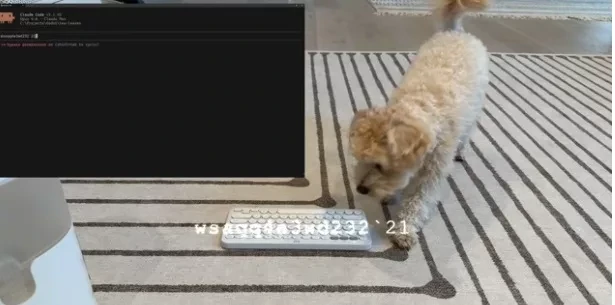
The experiment proposed by the author Caleb Leak involved making a neural network generate code for a video game based on commands from his dog. Momo, by pressing keys with her paws, provided the input, and the AI transformed this chaos of symbols into a finished project.
For this experiment, a dog named Momo, a Cavapoo breed, was chosen. The owner placed a Bluetooth keyboard on the floor, which was connected to a Raspberry Pi 5 single-board computer. Each time Momo pressed the keys, a smart feeder rewarded her with a treat.
The recorded keystrokes were not wasted. A special application written in Rust sent these keystrokes to the AI service Anthropic Claude Code. The requests looked like random strings of characters, for example: "skfjhsd#$%" and similar.
To prevent the neural network from rejecting meaningless strings, Caleb devised a backstory for it. He imagined the AI as an eccentric game developer who uses encrypted commands. The task of the neural network was to decipher these commands and create code for the game.
The method proved successful. The time from the first paw presses to the completed game varied from one to two hours. The development process was carried out on the Godot 4.6 engine, and the game logic was coded in C#.
One of the results was a project called Quasar Saz. In the game, the main character named Zara battles with distorted sound. It features six levels and a final boss battle, with graphics styled after the 1980s.
The experiment demonstrated that modern neural networks are capable of generating working code even based on requests consisting of meaningless words.