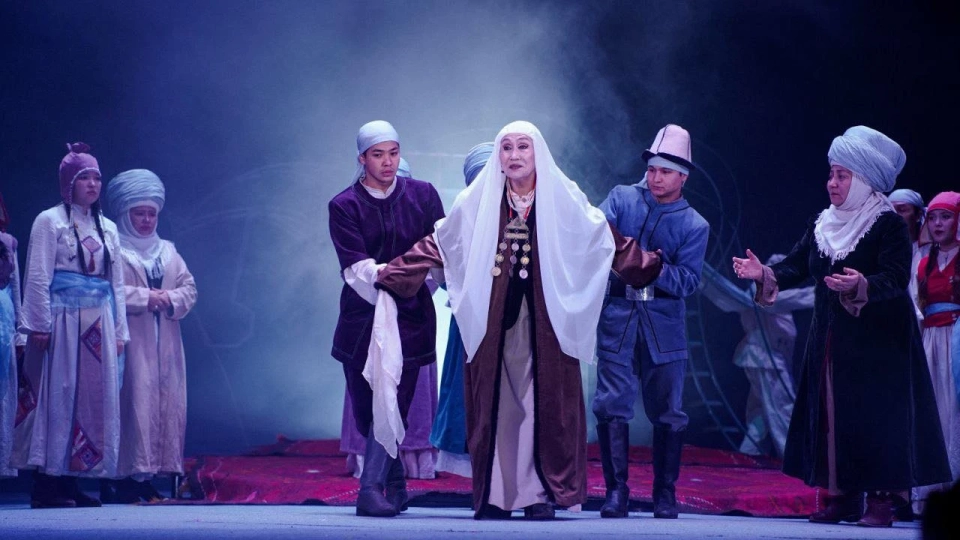
In chronological order, the names of the manaschy are presented, and their stories are enriched with poems written by manaschy Rysbai Isakov. Nurbek Talantbekov emphasized that manaschy and their art should not be viewed merely as entertainment, but as an important part of culture.
How many names of manaschy have survived to our time, and how many have gone unnoticed in historical records? The public still does not know the exact number of existing manaschy.
According to the author, his task is to convey to the people the names of all manaschy, and this list will be updated in future editions.
In the AKIpress section "The History of Manaschy," we provide detailed accounts of the life and work of each of the 150 manaschy.
Ashymbay uulu Mambetaly (Kökcheke) (1897–1969)
Mambetaly was born in the picturesque Syrt valley, located in the Ak-Suu district. He belonged to the Aryk clan of the Bughu tribe. His father, Ashymbay, was renowned as a craftsman, while his mother was a skilled storyteller. From a young age, Mambetaly showed an interest in music and singing, which soon made him famous in his village.
By participating in celebrations and festivities, he became popular among the locals due to his talent. From childhood, he absorbed knowledge from his mother and the elders of his village, studying legends and epics, including "Manas," which were recounted by his fellow villager Kaiduu and neighbor Zhuguru.
When he was 16 or 17 years old, a famous storyteller named Choyuke arrived in Kayirma-Aryk, who recited the epic "Manas" during the winter. Mambetaly, already familiar with the tradition, began to listen attentively to him and soon became his student, learning alongside Sayakbay and immersing himself in the world of "Manas."
At first, he merely retold the texts he heard; however, starting at the age of 25, as he himself claims, he began to draw inspiration from Alambet and started performing the epic in a deeper and more original format. At the age of 26-27, he also received lessons from manaschy Shapak, who lived in Kochkor.
During the collectivization in the USSR, Mambetaly became the first member of the artel and called on his fellow villagers to unite. In 1937, he joined the amateur art circle in his collective farm and soon began to tour the regions. In 1939, he performed at the decade of Kyrgyz literature and art in Moscow, where he recited a passage from "Manas" — "The Tale of Alambet." After that, he returned to his homeland and was accepted into the Issyk-Kul Regional Drama Theater, where he worked until 1944.
Recordings of his versions of parts of the epic "Manas," such as "Manastyn Kanykeyge uylenushi," "Kökötöydün ashy," "Alambettin jomogu," and "Kongurbaydyn chabuulu (Chon kazat)," were made in 1962, and in 1967 — the epics "Semetey" and "Seitek." These recordings were transferred to the manuscript fund of the Kyrgyz National Academy of Sciences. Mambetaly was also well-versed in folk tales and bylinas, which he skillfully recounted and left as a legacy for future generations.
Rysbai Isakov describes Mambetaly in his work "Manaschylar" as follows:
Like a river flowing with a roar,
Like a shield covering the storm.
His voice, booming like thunder,
Like a hawk soaring with the melody.
Like an eagle that strikes with fervor,
Like a flame igniting in the twilight.
He speaks with strength, they say,
Like a winner claiming a prize.
Burning like a fire in the night,
Not stopping even for a moment.
They say he recites Mambetaly,
Always aiming for the target.
When he speaks with true strength,
His essence gathers like honey.
His eyes shine brightly, they say,
With a blue forehead glowing brightly.
Therefore, the nickname Kökcheke,
Has been forever etched in his name.
With this rhythm, we too,
Have spoken his name in remembrance.