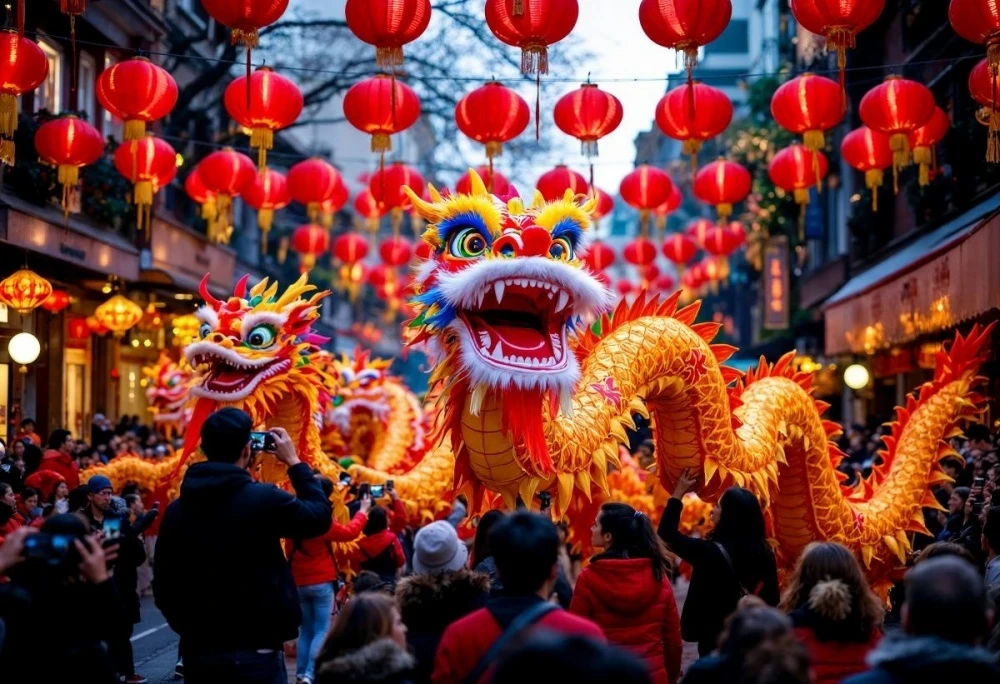
The celebration of the Chinese New Year, also known as the Lunar or Spring Festival (Chun Jie), is about to begin. This event has a rich history spanning several millennia, filled with legends and unique customs. In this article, we will discuss when this holiday will be celebrated in 2026 and how it is celebrated in China.
Historical Roots of Chun Jie
The Chinese New Year has deep historical roots dating back to the Shang Dynasty (1766-1122 BC), when agrarian communities celebrated the beginning of spring work. Over the centuries, the holiday has evolved, enriched by various traditions and customs specific to different regions of China. Each locality has contributed its own features to the celebration—from traditional dishes to unique events. For example, in Yunnan, lantern-launching competitions are held, while in Shandong, stilt parades are popular.
When the Holiday is Celebrated and the Symbol of Fire
The Chinese New Year, according to the lunar calendar, falls on the second new moon after the winter solstice. In 2026, the holiday will be on February 17, lasting for 15 days and concluding on March 3. The Year of the Fire Horse will end on February 5, 2027. Although China transitioned to the Gregorian calendar in the 20th century, the lunar calendar remains significant in the cultural life of the country. The year 2026 in the Eastern calendar will be the 4724th year. Additionally, other holidays are marked according to the lunar calendar, and many Chinese people use it to determine birthdays and ages.
Each year in the Chinese calendar is associated with one of the twelve zodiac animals, and 2026 will be the Year of the Red Fire Horse. The previous years were represented by the Green Wooden Snake (2025) and the Green Wooden Dragon (2024), while 2027 will be the Year of the Red Fire Goat. The horse in Eastern culture symbolizes speed, vitality, and the pursuit of success, while the element of Fire enhances these qualities, adding passion and courage. The color red will dominate the celebrations, as it is considered a color of luck and protection against evil forces.
Traditions and the Color Red in the Celebration
The Chinese New Year encompasses numerous traditions, such as family dinners, festivals, and public celebrations. One of the main symbols of the holiday is fireworks, which have their roots in myth.
According to legend, long ago there was a monster named Nian that emerged from the sea to attack people and livestock. One day, an old man dressed in red scared the monster away with the loud crackling of burning bamboo. Since then, people began decorating their homes in red and setting off fireworks to drive away Nian.
The color red has become a symbol of the Chinese New Year. Red lanterns are hung in homes, and money is given as gifts in red envelopes. Red decorations and inscriptions on doors are also an integral part of the celebration. It is believed that the color red brings good luck, so traditionally, people wear red clothing and cover tables with red tablecloths to attract financial prosperity in the new year.
Parades with lion and dragon figures are another significant tradition, where the lion symbolizes grandeur and courage, while the dragon represents luck and change.
The Lantern Festival concludes the New Year celebrations. People light lanterns of various shapes and sizes, symbolizing hope and happiness. Notes with riddles are attached to the lanterns, and those who find the answers can receive small gifts.
Preparations for Chun Jie begin a month before the holiday. This period is called Xiao Nian, or the Little New Year, and each day has its significance for ensuring good luck in the new year. An important part of the preparation is a thorough cleaning to "sweep out the old" and not "sweep away luck" during the festive days.
The Chinese strive to settle all debts before the new year begins, as there is a saying: "new year - new account." Unpaid debts can "carry over" into the new year and cause financial difficulties.
Buying flowers and plants with symbolic meanings is another tradition. For example, peach tree branches symbolize longevity, narcissus flowers represent wealth, and mandarin trees signify luck and prosperity.
Modern China experiences a massive migration of people during the holidays, known as "Chun Yun," when millions return to their hometowns to reunite with families. Every year during this period, more than 3 billion trips are made over 40 days, making ticket booking an important part of the preparations.
Symbols of the Holiday
The festive period of the Chinese New Year is a time of vibrant traditions, each with deep symbolic meaning. The celebration begins with the New Year's dinner, which is the most important family event. All family members gather around the table, including those who come from afar.
On the New Year's table, symbolic dishes must be present: a whole fish symbolizes abundance, long noodles symbolize longevity (they should not be cut), jiaozi dumplings resemble gold ingots, sweet rice balls (tangyuan) symbolize unity and happiness, and the New Year cake (niangao) symbolizes the increase in prosperity.
Setting off fireworks and firecrackers at midnight is not just a spectacle, but a ritual aimed at driving away evil spirits and attracting good luck. In recent years, fireworks have been restricted in major cities due to air pollution, but this tradition is preserved in rural areas.
The New Year's morning begins with greetings. Children bow to adults, wishing them longevity and prosperity, in return receiving red envelopes with money. Today, digital red envelopes through payment apps are becoming increasingly popular.
The Chinese New Year is not just a date on the calendar, but a whole world of symbols and traditions reflecting the centuries-old wisdom of the people. Understanding the history of the holiday and its rituals opens the key to understanding Chinese culture. By wishing "Xin Nian Kuai Le!" you are not just wishing happiness in the new year, but becoming part of a living cultural tradition that connects the past with the present.
It is worth noting that the celebration of the Chinese New Year is also widespread in educational institutions and joint Chinese-Kyrgyz enterprises in Kyrgyzstan.
Source: silunews.kg