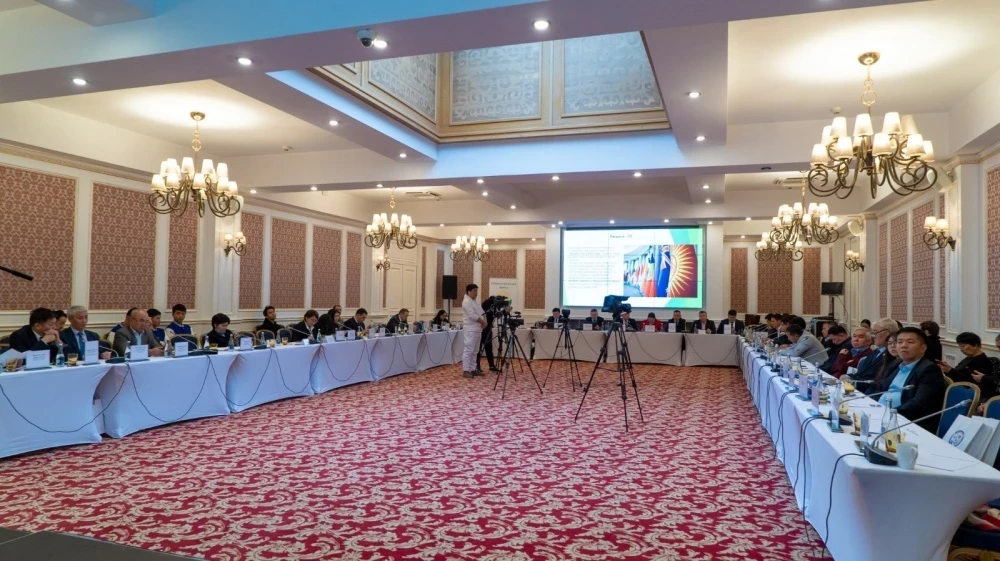
The topic of water security in Kyrgyzstan, the resilience of mountain ecosystems, and climate change was at the center of a conference held in Bishkek titled: "Water, Mountains, and Glaciers of the Kyrgyz Republic. Sustainable Future." This event was organized by the J. Balasagyn Kyrgyz National University, the Green Energy Public Foundation, the OYUL "Oiy Ordo" Center for Environmental Initiatives, and the Green Alliance of Kyrgyzstan. The main goal of the meeting was to promote Kyrgyzstan as an important mountain state in the region and a supplier of fresh water, as well as to create a platform for dialogue on water and climate issues.
Almaz Musaev, Deputy Minister of Natural Resources, Ecology, and Technical Supervision of the Kyrgyz Republic, emphasized that Kyrgyzstan, being a landlocked mountain country, occupies an area of 199,900 sq. km, which is only 0.13% of the total land area of the planet. The Republic is among the 200 priority ecological regions of the world, home to about 2% of the world's flora and 3% of fauna.
According to Musaev, the mountain ecosystems of Kyrgyzstan play a crucial role in shaping unique climatic conditions, providing shelter for rare species and creating vertical zonation from deserts to alpine meadows. The country's glaciers serve as a key source of fresh water necessary for drinking, irrigation, and hydropower. In 2024, the glaciers were included in the list of specially protected natural areas.
He also noted that on March 1, 2022, the Cabinet of Ministers of the Kyrgyz Republic approved a Roadmap for the Year of Protection of Mountain Ecosystems and Climate Resilience, and launched a national campaign called "Green Legacy." In 2023, another decree was adopted, aimed not only at the successful implementation of this campaign but also at ensuring environmental safety, improving the environment, and preserving forests for future generations.
Musaev reminded that Kyrgyzstan initiated the global summit "Bishkek+25" in 2027, which will be an important event in the international mountain agenda. The summit will discuss key issues such as glacier melting, climate change, and biodiversity loss, which will help develop new international solutions and strengthen cooperation among mountain countries.
Professor and Doctor of Economic Sciences Guras Japparov drew attention to the issues of economic valuation of water resources in Central Asia. He noted that various approaches to assessing the value of water resources show that water should have a price, and this opinion is supported by many experts. In some cases, charges are levied for water use, including compensation for hydraulic structures and ecosystem services.
The speaker emphasized that there are many examples of transboundary cooperation in water resources around the world, and the experience of some countries shows that the joint use of large rivers can be successful. However, sometimes this cooperation can turn into disputes, and in some cases, unresolved issues remain.
As noted by Chinese expert Liu Qing, effective use of water resources requires the implementation of market mechanisms, creating a water use market based on rights to use water bodies. In a market environment, the price of water should be formed taking into account demand and the full cost of water supply.
Japparov also pointed out the need to consider conditions in neighboring countries when it comes to transboundary rivers. Water obtained from such rivers is often regarded as a "Divine gift," which complicates its valuation.
To address the issues of economic mechanisms for regulating water-energy issues in Central Asia, it is necessary to consider the real situation:
- The Toktogul Reservoir operates in an energy mode;
- accumulation of water resources occurs during the growing season;
- the main water discharge from the reservoir occurs in the autumn-winter period for electricity generation, although irrigation is needed during the growing season;
- climate changes and prolonged periods of low water;
- growing electricity consumption in the region;
- lack of a regional electricity market to address shortages.
Japparov also noted that considering current electricity prices in Central Asia, the volume of regulation of the Toktogul Reservoir's flow during the growing season can be estimated at $32.5 million. This will allow for the preservation of water resources in the reservoir up to 0.8 billion m³.
He added that the opinions of well-known scientists, such as V. Dukhovny and Sh. Muminov, who proposed introducing the term "interstate water reserve" for reservoirs of multi-year regulation, should be taken into account.
Since 2010, there has been a natural increase in electricity consumption, as well as prolonged low-water cycles, leading to significant water expenditure from the Toktogul Reservoir.
In 2014, Kyrgyzstan changed its status from an electricity exporter to a net importer, highlighting the need to differentiate between countries regulating river flow, transit countries, and consumer countries.
The economic analysis showed that many problems require joint solutions with participants in water-energy cooperation, including issues of cost recovery and joint preservation of reservoirs.
It is necessary to develop specific mechanisms for water-energy cooperation, which requires the participation of all stakeholders.
It is important to continue the dialogue between Central Asian states on water-energy cooperation, using the best international practices on compensation mechanisms.
It is also necessary to consider the real costs incurred by Kyrgyzstan for regulation and the creation of hydraulic infrastructure, as well as to determine the role of neighboring countries in this process.
Creating a clear architecture for water-energy cooperation is crucial for effective management of water resources in Central Asia, which requires a more dynamic approach to water tariff policy, taking into account demand in the energy market," concluded Japparov.
Earlier, the rector of J. Balasagyn Kyrgyz National University, Doctor of Geographical Sciences, Professor Dogdurbek Chontoев, raised the issue of the inadequacy of economic principles of interstate water use, which creates problems for both Kyrgyzstan and the entire region.
He pointed out the need to introduce charges for water supply services for internal users, as Central Asian countries ignore market mechanisms for payment for water obtained from neighboring states, leading to significant costs for maintaining reservoirs and other hydraulic structures.
At the same time, many of these structures are in a dangerous technical condition, posing a threat not only to Kyrgyzstan but also to neighboring countries — Uzbekistan and Kazakhstan.
Central Asia represents a single territory where river systems, such as the Amu Darya and Syr Darya, sustain the region's livelihood. Therefore, reliable operation of interstate hydraulic facilities can only be achieved through the joint efforts of all countries.