Kyrgyzstan is entering a phase of active urbanization. According to UN estimates, by 2050 about 43.4% of the country's population will live in large cities, and the new master plan for Bishkek predicts the capital's population will grow to 2 million people. These figures indicate not only the expansion of cities but also significant changes in the economy and lifestyle.
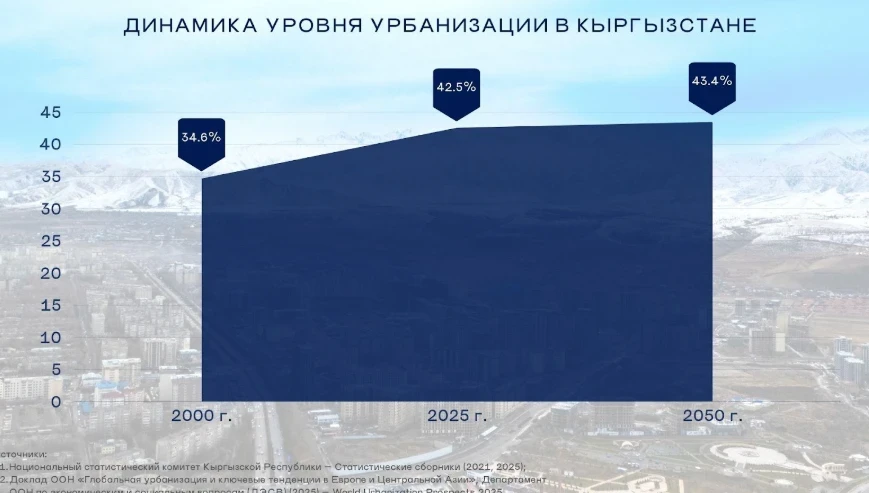
Dynamics of the level of urbanization in Kyrgyzstan
Urbanization serves as a powerful impetus for socio-economic development. The concentration of people and businesses in cities contributes to GDP growth, increased labor productivity, support for small and medium-sized enterprises, and the creation of new jobs. The urban environment provides access to education, healthcare, culture, and innovation, becoming a center for IT startups and scientific research. In the long term, this reduces emigration and forms a sustainable economy.
However, as cities grow, their problems also intensify: congested roads, increasing street crime, inefficient management processes, and bureaucracy. In the absence of a systematic approach to addressing these issues, these factors can negatively impact economic growth and living standards. Therefore, modern digital and intelligent technologies are becoming an important tool for data-driven city management.
Problems as opportunities for growth
The increase in population in Bishkek, Osh, and regional centers creates additional pressure on transportation and utility services, as well as on government bodies. Outdated management models do not meet modern realities. In such conditions, technology becomes not just a fashionable trend but a necessity for the survival of large cities.

City of Bishkek
Traffic jams: technology guarding the freedom of movement
One of the most pressing issues is road traffic. Traffic jams in the capital have become a common occurrence, and their cause lies not only in the number of cars but also in inadequate traffic management. Modern technologies allow for a transition from static schemes to dynamic traffic management systems.
Bishkek has already implemented the "ASUDD" (Automated Traffic Management System), which allows for real-time monitoring and regulation of traffic flows. The introduction of "smart" traffic lights is also planned, which will prioritize buses, as well as the creation of dedicated lanes for public transport in Bishkek, Osh, and other cities such as Manas, Talas, Tokmok, Batken, Naryn, and Karakol. These measures will help increase the speed and predictability of public transport, which, in turn, should lead to a reduction in the number of personal vehicles on the roads.
Surveillance cameras installed as part of the "Safe City" project also play an important role. They contribute to increased driver discipline and a reduction in accidents due to the inevitability of punishment. According to the monitoring center of the Traffic Safety Department, in areas of Bishkek with installed cameras, the number of traffic accidents has decreased by 3.5%, while in the Chuy region, it has decreased by 14%.
Safety: digitalization against crime
The increase in population density requires new approaches to ensuring safety. The traditional model of responding to crimes is becoming insufficiently effective, giving way to a preventive approach based on data.
The "Safe City" and "Safe Country" programs are showing significant results: since 2021, the crime rate in Kyrgyzstan has decreased by 69%. Video cameras and analytics systems help not only record violations but also solve crimes, including high-profile cases.
Integrating video surveillance with emergency services reduces response times, while the presence of cameras decreases street crime in protected areas. As a result, a safer urban environment is created, where technology serves as protection and prevention, rather than tools of total control.
Bureaucracy: the path to a service-oriented state
Bureaucracy is another issue that needs to be addressed in growing cities. In accordance with the decree of the President of the Kyrgyz Republic, a program for debureaucratization began last year. It aims to simplify procedures, eliminate unnecessary certificates and requirements, accelerate the provision of public services, transition to digital document management through the Tunduk system, and improve the efficiency of public service work.
Digitalization is becoming the key to reducing the burden on government bodies and citizens. In 2025, the Centers for Public Services received 3.6 million requests, of which 527 thousand services were provided in digital format. More than 190 public services are available on the Tunduk platform, and the total number of users of the application is about 3 million. Digitalization covers all areas of public administration, leading to a decrease in the number of visits to institutions, reducing the influence of the human factor, and increasing transparency.
The transition to a service-oriented state changes the very approach to interaction: the state becomes a convenient service provider rather than a source of barriers for citizens and businesses.

Bishkek, photo by Nikolai Gladkov
The city of the future: the direction of digitalization
Despite the successes achieved, the path to a "smart city" in Kyrgyzstan remains challenging. The main obstacles include the fragmentation of solutions, a lack of qualified personnel, and the need to improve infrastructure. The next important step is to integrate transportation systems, security systems, and public services into a single digital platform for collaborative data work. For this, the government is cooperating with technology partners who assist in accelerating the creation of a digital economy and share international best practices.
As noted by Ilya Belyakov, Director of the Technical Department of the INTEGRA CITY Group of Companies, for residents, a "smart city" means not only sensors and cameras but also reduced traffic jams, faster services, and increased safety. The problems of cities are often not related to the lack of technology but to their insufficient integration, leading to inefficiency. Modern technologies can consolidate data into a single management platform, allowing for the anticipation of problems before they arise and responding effectively.
Big data and artificial intelligence open special prospects for solving old problems. They help transition from merely addressing issues to predicting them. As stated by the Minister of Digital Development Azamat Zhamangulov, the necessary capacities and infrastructure for implementing AI in the work of government bodies and businesses will be available in Kyrgyzstan by 2026.

City of Bishkek. Photo by Nikolai Gladkov
Urbanization in Kyrgyzstan opens new opportunities but requires effective management, the implementation of digital solutions, and a data-oriented approach. Technologies do not replace urban management but make it more efficient, transparent, and scalable.
Thus, problems such as traffic jams, crime, and bureaucracy can be transformed into manageable processes. This creates a chance for the cities of Kyrgyzstan not only to grow in size but also to become more convenient, safe, and economically sustainable.