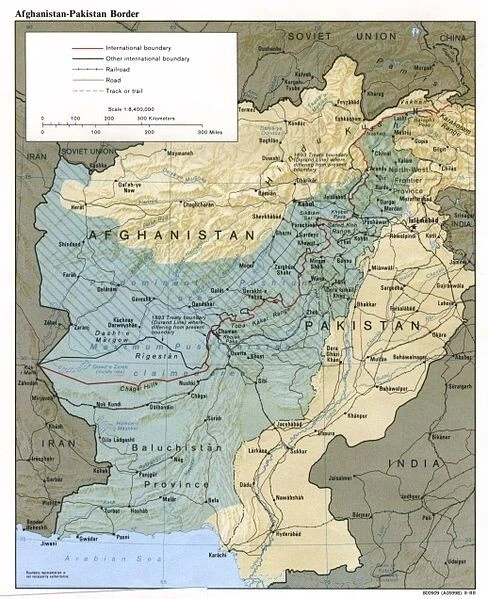
The military actions on the border of Pakistan with Afghanistan have resumed after a brief period of calm that lasted only a few months. The new escalation of the conflict was triggered by airstrikes conducted by the Pakistani Air Force on the provinces of Khost and Paktika on February 22, 2026. Islamabad claims that the strikes are aimed at terrorist bases of the "Tehrik-e Taliban Pakistan" (TTP), however, the Afghan side perceives this as a violation of its sovereignty. In response, the "Taliban" initiated a "special operation" along the Durand Line, attacking Pakistani border posts using artillery and FPV drones, which came as a surprise to the Pakistani army.
This conflict demonstrates the clash of different strategies and eras. On one side stands nuclear Pakistan with an army of 660,000 equipped with modern F-16 and JF-17 fighter jets. On the other side are the combat units of the "Taliban," numbering around 200,000, whose aviation is limited to captured helicopters and drones. Nevertheless, despite Pakistan's technological superiority, the Taliban's experience in guerrilla warfare allows them to effectively utilize the local terrain and the support of Pashtun tribes, making control over the border an extremely challenging task for the Pakistani military.
The main issue lies in the Durand Line, which was established in the late 19th century and divided Pashtun territories. Since 1947, Afghan authorities have not recognized this border, considering it arbitrary. Currently, this area has become a "gray zone" where the interests of states and tribal ties intersect. For Pakistan, military actions often represent a way to "save face" in front of the population against the backdrop of internal problems and separatist movements in Balochistan. Meanwhile, Kabul uses external threats as a means to consolidate society and divert the attention of radical elements towards an enemy beyond its borders.
Experts do not expect a protracted war. Pakistan is facing serious economic difficulties and is unable to conduct a full-scale military campaign on two fronts, considering the conflict with India in the east. At the same time, Kabul is actively developing trade routes to Iran (Chabahar port) and Central Asia, seeking to reduce dependence on Pakistani transit. This creates a new dynamic: the economic rift between the two countries exacerbates their relations. As long as the Pashtun factor and TTP activity dominate the border, local conflicts along the Durand Line will remain a common occurrence in regional politics. Islamabad and Kabul will continue mutual attacks, balancing on the brink of a major war, which is disadvantageous to either side, but for which both sides are preparing daily.