The research team is studying the potential consequences.
Recent observations by scientists have recorded the beginning of the movement of the Thwaites Glacier in Antarctica. This glacier, known as the "Doomsday Glacier," represents one of the most dangerous natural structures for the world's oceans. This information is reported by "Radio 1."
In terms of size, this glacier is comparable to the United Kingdom. Scientists warn of serious consequences: the complete melting of the glacier could lead to a rise in ocean levels of at least 60 centimeters, and in the worst case, by 3 to 5 meters.
This scenario could trigger a chain reaction affecting other glaciers. Satellite data shows that warm ocean waters are actively eroding the base of Thwaites, contributing to the formation of cracks.
Reasons for the name "Doomsday Glacier"
The Thwaites Glacier, located in West Antarctica, covers an area of about 192,000 square kilometers, which is comparable to the territory of the United Kingdom. It plays a key role in holding back vast masses of ice from the entire West Antarctic Ice Sheet. The loss of this glacier could destabilize the entire region.
Climatologists warn that if Thwaites melts, ocean levels will rise by at least 60 cm. More concerning is that this process could activate a chain reaction, resulting in sea levels rising by 3 to 5 meters. This would threaten millions of residents in coastal cities and cause significant damage to the infrastructure and economies of many countries.
Accelerating Destruction Processes
It was previously thought that Thwaites was stable, as its base is located on the seabed. However, recent satellite and hydrological observations have shown that warm ocean currents are penetrating beneath the ice, eroding it and creating cavities and cracks up to hundreds of meters deep.
These changes make the glacier more vulnerable than previously thought. Scientists believe that the impact of global warming on Thwaites has been underestimated, and the actual rate of its destruction may exceed current forecasts.
Lessons from the Past: Ancient Climate
Paleoclimate data show that similar large-scale glacier destruction occurred on Earth about 120,000 years ago, leading to a sharp rise in ocean levels. Modern studies allow for comparisons between these events and current processes to assess the speed of a possible similar scenario.
If history repeats itself, the consequences could occur much faster than the most cautious forecasts suggest.
Expedition Progress
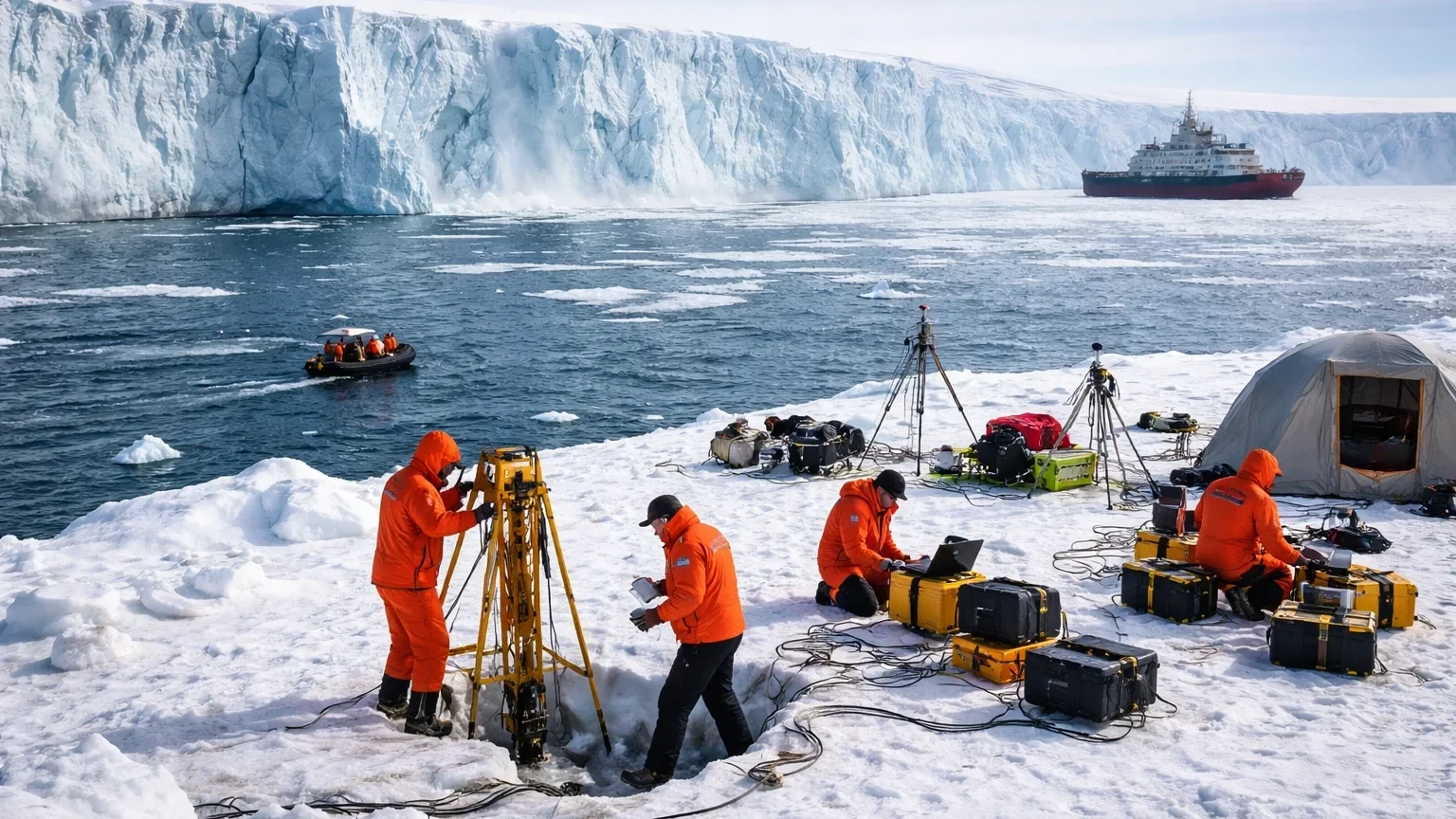
The expedition, which started from New Zealand on the South Korean icebreaker "Aaron," includes about 40 participants, including scientists and journalists. Work near the glacier's edge is planned for a month.
Conditions are extremely challenging: the glacier moves at a speed of up to nine meters per day, which creates a risk of damage to equipment installed on the surface. Additionally, harsh weather conditions with low temperatures and strong winds add to the difficulties.
Innovative Technologies and Methods
Modern methods are used to study the glacier, such as airborne radar scanning, which allows researchers to investigate the internal structure of the ice, and drilling to depths of up to 800 meters to install sensors. Additional equipment is dropped from helicopters in hard-to-reach areas.
One of the original solutions has been the use of seals, to which miniature sensors are attached to measure temperature and salinity of water at depths of up to 500 meters. This data is transmitted via satellite, allowing scientists to obtain unique information without risking the expedition.
Global Significance of Research
The results of this research will help refine models of global ocean level rise and create more accurate forecasts for the coming centuries. This data is critically important for global strategic planning, from developing coastal protection systems to assessing insurance standards and infrastructure placement.
The future of millions of residents in coastal areas directly depends on understanding the stability of Thwaites. The answers obtained during this expedition could prove crucial in the fight against the consequences of climate change.