The expected sudden stratospheric warming in February 2026 may trigger a new collapse of the polar vortex, which in turn will lead to an influx of Arctic air into North America and Europe.
According to the World Meteorological Organization, since 1950 there has been a decline in the frequency and intensity of extreme cold events globally, while winter temperatures are gradually rising, as indicated by data from the Intergovernmental Panel on Climate Change (IPCC). However, long-term climate trends do not rule out the occurrence of extreme weather events or regional cold spells.
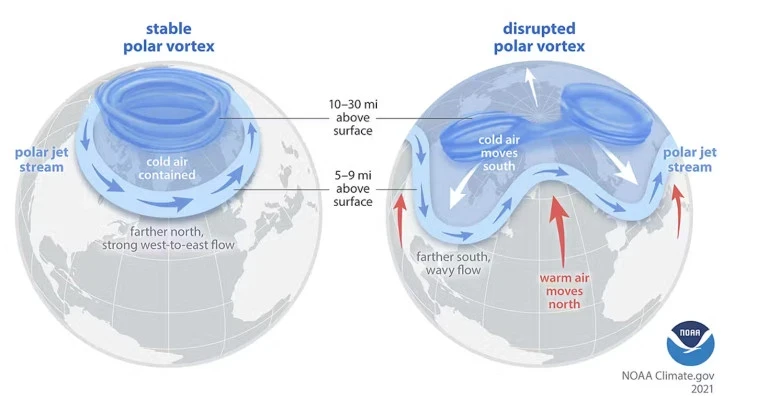
Recent changes in the polar vortex, caused by its weakening and deformation, have led to increased waviness of the polar jet stream, which has facilitated large-scale invasions of icy air into the mid-latitudes. These processes have resulted in a sharp drop in temperatures in North America, Europe, and Asia, creating conditions for destructive winter storms in January.
The polar vortex is a powerful flow of cold air and strong winds that typically forms a closed circulation around the North Pole. When the vortex weakens, Arctic air rushes southward, while warmer air masses are displaced into the Arctic.
Some meteorological estimates suggest that a major sudden stratospheric warming in early February could significantly weaken the polar vortex, creating additional threats for the influx of Arctic air into North America and Northern Europe by the end of February.