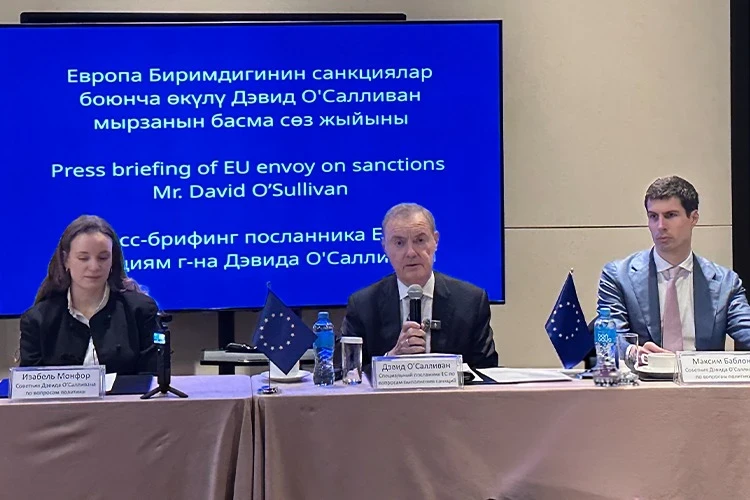
During the dialogue, the parties discussed issues related to sanctions policy.
Previously, O'Sullivan emphasized that the European Union attaches great importance to cooperation with the Kyrgyz Republic. Sanctions are one of the tools used by EU countries to influence Russia in foreign policy. However, the issue of circumventing these sanctions raises serious concerns among European authorities.
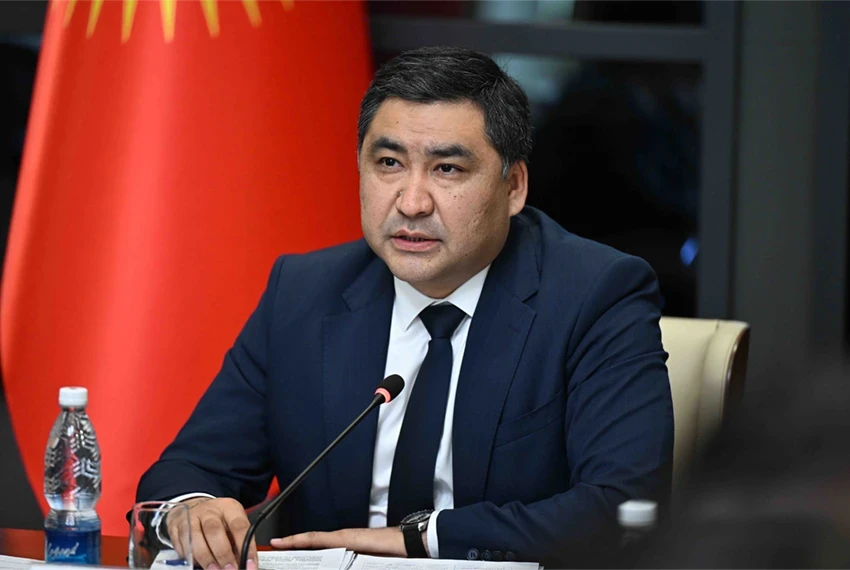
Daniyar Amangeldiev noted that Kyrgyzstan adheres to a pragmatic approach to risk management and is actively working to enhance compliance measures, transparency, and financial monitoring in international economic operations.
Control is also necessary for European exporters
The Kyrgyz side emphasized that effective export and financial control requires shared responsibility among all participants in foreign economic operations, including European suppliers.
Kyrgyzstan also underscores the importance of European suppliers fulfilling their export control obligations, including due diligence on counterparties, proper documentation of transactions, and providing a complete set of supporting materials for the verification of end users and the designation of goods.
Sanctions and the financial sector
Previously, financial institutions and crypto companies from Kyrgyzstan were included in the 19th package of sanctions from the European Union.
The Kyrgyz side reported on its efforts to improve control mechanisms in commercial banks, which include comprehensive checks of transactions and blocking transactions that may violate requirements.
The Cabinet also notes the need to create clear and transparent mechanisms that include unified risk assessment criteria, agreed procedures, and timely feedback, as well as the use of reliable and up-to-date information for decision-making and coordination of actions.
Commercial banks under sanctions
During the discussion, the importance of developing a joint action plan and determining the format of technical cooperation for gradually resolving issues related to restrictions on certain commercial banks was emphasized.
The 19th package of EU sanctions included "Tolubai Bank" and "Eurasian Savings Bank".
EU Special Envoy David O'Sullivan indicated that transparency is the main guarantee of trust from European institutions and the international community.
He also added that specific proposals for further technical cooperation aimed at removing Kyrgyz banks from the sanctions list and minimizing future financial risks had been sent to the Kyrgyz side.
The envoy emphasized the EU's expectations regarding progress in strengthening export and financial control mechanisms.
In January 2026, Bloomberg reported that the European Union was preparing new restrictive measures against Kyrgyzstan due to suspicions of assisting Russia in circumventing sanctions.
As part of the new sanctions package against Moscow, the EU is considering applying a mechanism to counteract the circumvention of sanctions, which could prohibit the export of certain equipment and radio equipment to Kyrgyzstan.
The possible introduction of new sanctions against Kyrgyzstan was commented on by the First Deputy Chairman of the Cabinet of Ministers Daniyar Amangeldiev at the Munich Security Conference.
He stated that the government of Kyrgyzstan regularly interacts with EU Special Envoy for Sanctions David O'Sullivan on this issue.
Amangeldiev noted that Kyrgyzstan's selection as a target of EU sanctions raises concerns and is perceived as an attempt at intimidation, which the Kyrgyz side categorically disagrees with.
Note:
Since the beginning of 2022, more than 20 companies from Kyrgyzstan, including major banks and oil and gas companies, have been sanctioned by the U.S. and U.K. Treasury. Secondary sanctions apply not only to financial institutions and the oil sector but also to companies engaged in:
- the supply of electronic and telecommunications equipment,
- IT infrastructure,
- aviation fuel,
- air transport, and other goods.
Economist Robin Brooks from the Brookings Institution reported a significant increase in export supplies from Europe to Kyrgyzstan: from Estonia — by 10,000%, from Finland — by 3,100%, from Poland and Greece — by 2,200% and 2,100%, and also more than 1,000% from Norway, the U.K., Germany, and the Czech Republic.