— Daniyar Dzholdoshovich, it is obvious that the external environment is becoming more complicated. Sanctions are expanding, and the rules are changing on the go. How do you assess the vulnerability of Kyrgyzstan's economy in this situation?
— An open economy is always subject to changes in the global regulatory environment, and Kyrgyzstan is no exception. At the same time, what is more important than vulnerability is the quality of risk management.
We understand that the sanctions environment is not just political talk, but a reality that must be dealt with professionally. Our task is not to react emotionally, but to create a system of preventive adaptation: this includes transparent calculations, correct logistics, compliance with compliance procedures, and constant dialogue with regulators and partners.
For a small-sized economy, this requires discipline. It is important not to make loud statements, but to maintain accuracy and consistency in actions. The better you understand the existing rules, the less likely you are to face crisis situations.
— Can you clarify what you mean by the term "small economy"?
— This is not a subjective assessment, but an economic term. An economy is considered small if it has a limited domestic market, a high degree of openness, and dependence on external trade and financial flows. In such economies, the impact of external decisions, such as sanctions and trade restrictions, is felt much faster and more noticeably than in large countries with diversified domestic demand.
Nevertheless, a small economy has its advantages: it is more flexible and adapts more quickly to changes, allowing for adjustments in models without destroying internal structures. In this context, "small" does not mean weak; it is simply a more sensitive economy that requires quality management.
For our country, this is a matter of efficiency, where the compactness of the system emphasizes the importance of precise decisions.
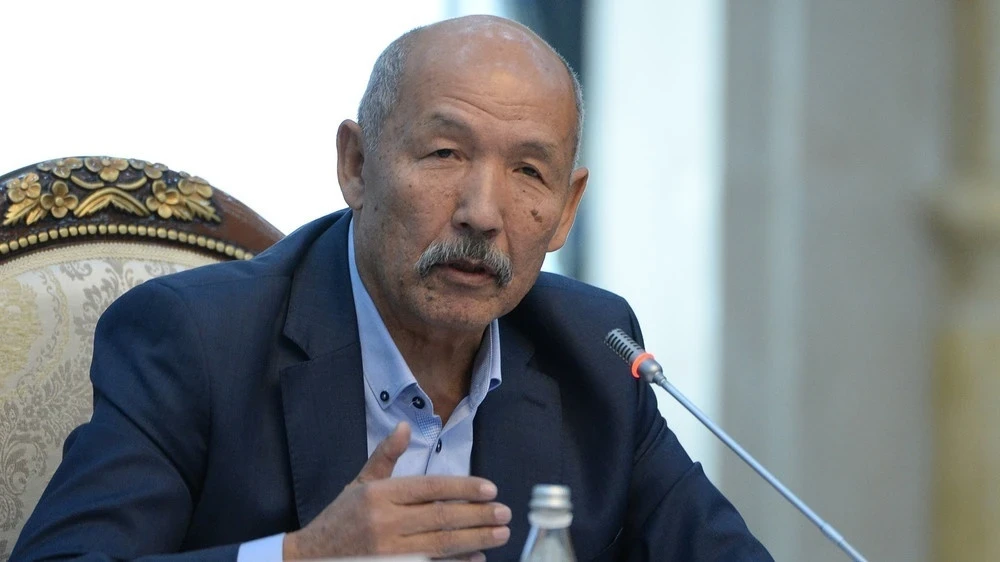
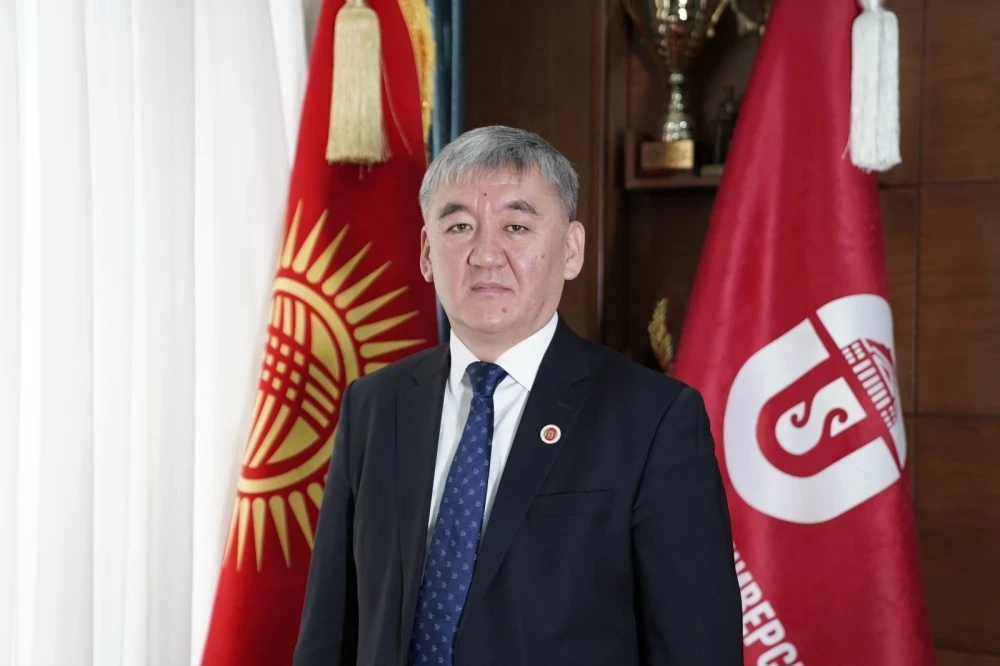
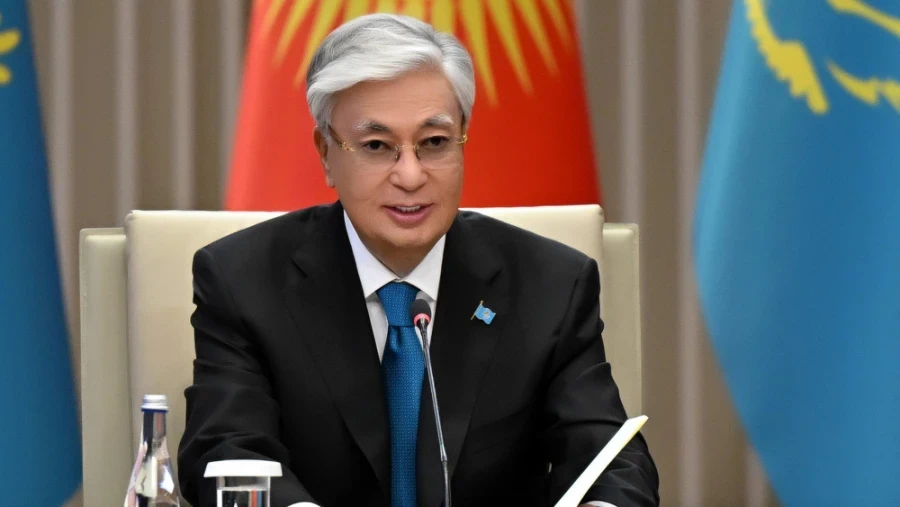
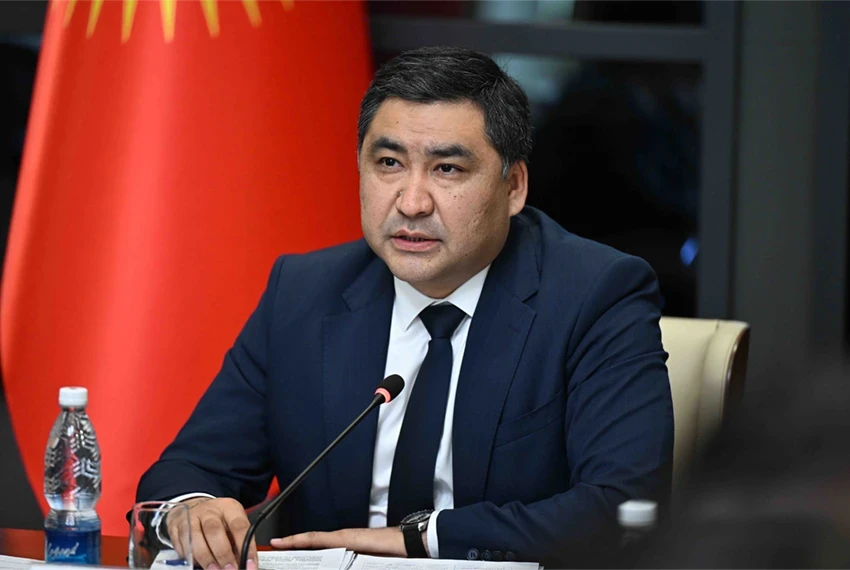
Photo from the archive. Daniyar Amangeldiev
— Let's return to sanctions. At the end of January, media outlets, including Bloomberg, reported that the European Union might consider including Kyrgyzstan in a new sanctions package. What are the risks of this step?
— We are closely monitoring discussions about new EU sanctions packages. When a country is actively involved in external trade and transit, the risks of discussions are always present, which is part of the modern global economy.
It is important to realize that sanctions serve as a regulatory tool, not a chaotic process. They are based on procedures and facts, and our task is to work precisely within this logic.
We are developing a systematic model for risk minimization, including explanatory work with businesses, strengthening financial monitoring, cooperation with European structures, and increasing the transparency of export operations.
Kyrgyzstan's position is as pragmatic as possible — we strive for a predictable and transparent economic model.
Any decisions should be based on objective data, not assumptions.
Daniyar Amangeldiev
It is critically important for us to maintain the reputation of a responsible and reliable partner.
— How do you manage to do this? It is known that you actively participate in negotiations on sanctions issues. Are there any internal nuances you can share?
— There are no special secrets, but even if there were, sanctions diplomacy is not about publicity. It requires careful wording and an understanding of the consequences of each step.
These negotiations always represent teamwork. We operate within the strategy set by the country's leadership. My task is to ensure the professional component of the process, including economic analysis, legal expertise, and technical accuracy of decisions.
— Kyrgyzstan is increasingly mentioned as a bridge between different economic spaces. Is this a strategic decision?
— It is more about pragmatism. Geographically and historically, we are at the crossroads of trade routes. Our task is to rationally use this position by developing logistics, ensuring financial transparency, and reducing transaction costs.
The role of a bridge for us is not a geopolitical ambition, but an economic function that requires care and adherence to international norms. A bridge can only be sustainable when it is safe to cross.
— You are clearly a team player and a technocrat. How would you describe yourself?
— I would say that I am a person of the system. I am close to the logic of precise decisions. Working in the public sector for me is about responsibility for consequences, not for loud headlines.
— What does responsibility in public administration mean to you?
— Responsibility is the ability to think one step ahead of applause. Working in the government is rarely spectacular; more often, it is a choice between quick and correct, and the right decision often looks less impressive.
We live in an era when publicity often overshadows content.
Daniyar Amangeldiev
Nevertheless, the economy obeys simple laws: trust is built over years and destroyed in an instant.
And to be direct, my task is to ensure that in five or ten years, our current decisions do not appear bold, but reasonable.
— And finally, if we step away from current topics, what do you see as the main challenge for Kyrgyzstan today?
— The main challenge, in my opinion, lies in the ability to maintain internal calm in a world that constantly pushes for sharp actions.
Small states often react quickly and loudly, but resilience depends not on the speed of reaction, but on the quality of decisions made.
The strength of a country is not in being noticeable at any cost. Strength lies in predictability and the ability to keep one's word.
Daniyar Amangeldiev
It is important for partners to understand that if Kyrgyzstan states something, it is not a temporary position, but a carefully considered strategy. We must be able to maintain calm, even when there is a lot of noise around.