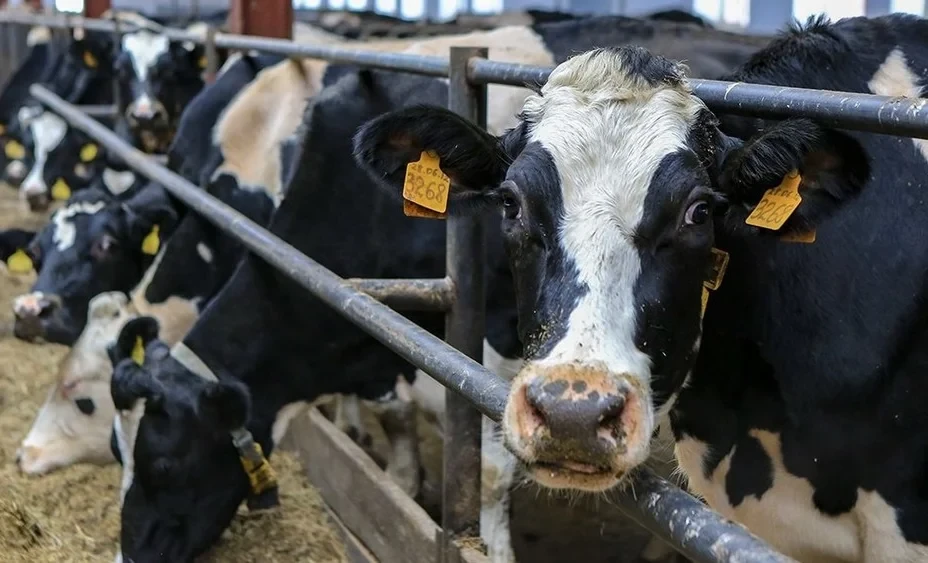
He specializes in the Aberdeen-Angus breed, which is focused on meat production. Starting with two calves, his herd now exceeds 50, and the total number of cows on the farm has reached 130.
“My experience in breeding livestock spans almost three decades. Previously, I dealt with dairy cows, but for the last 15 years, I have switched to meat production. The Aberdeen-Angus cows I have now were brought here in 2013 as part of an international project. At that time, I could only purchase two calves due to limited financial resources, as our farm was selected among the large farming enterprises in the country,” Kahar shared.
This breed adapts well to local climatic conditions, and he has not encountered any problems with their acclimatization. He also noted that the cows are not picky eaters: they consume both hay and compound feed. Every year during the summer, they go to the summer pastures in the direction of the Toguz-Toro district, tolerating both cold and heat well.
Although Aberdeen-Angus cows do not produce a lot of milk—about 7-8 liters per milking—their milk has a high fat and cream content, making it suitable for calves that grow and mature quickly.
This spring, he sold calves born at the beginning of the season at the age of 5-6 months for 60,000-70,000 soms. This turned out to be a profitable decision. With good care, a fattened bull can reach a weight of 1,200 kg, and after slaughter, it yields 700-750 kg of meat. This year, he sold one bull for a record 397,000 soms. “Many people are interested in breeding this breed,” Eshkoziev noted.
He emphasized that the transition to quality in livestock breeding is a relevant task, but noted the lack of breeding animals on the market.
“Although the number of livestock in the country is increasing, pastures are decreasing. There is an opinion that we need to reduce the number of animals and improve their quality. However, breeding animals remain inaccessible to the population both in terms of quantity and price,” he added.
Eshkoziev suggested that it would be advisable for the government or the Ministry of Agriculture to organize the purchase of breeding livestock from abroad. Currently, when cows are indeed brought in, tenders are often held, and the companies that win tend to focus on profit rather than breeding qualities, opting for cheaper animals. Additionally, transporting livestock can cause many problems, especially if the animals go two days without feed or water, which negatively affects their health.
“An optimal solution would be to create centers for the procurement of breeding livestock in the south and north of the country, so that farmers and others interested could directly purchase animals and engage in their breeding. This would contribute to an increase in the number of breeding animals and a decrease in prices,” he summarized.
Kahar lives in the village of Ülgü and established a breeding farm called “Bakyt” many years ago.
In conditions where the price of meat on the market reaches 700-800 soms, he intends to continue increasing the herd of meat cattle.
- The Aberdeen-Angus breed, which is raised for meat production, originated in the Angus area of Scotland. Selection began in the 19th century, and now this breed is widespread in many countries. Angus meat is considered tasty, tender, and fatty.
if(aki_gallery==undefined){var aki_gallery=[];var aki_gallery_title=[];}
aki_gallery[308971] = new Array('cdn-1.aki.kg/cdn-st-0/qho/L/3865261.63b31838395cd9c3ae766726214ee710','cdn-1.aki.kg/cdn-st-0/qho/L/3865216.94c9b91eed826e8669c12015c84c4c60','cdn-1.aki.kg/cdn-st-0/qho/L/3865256.7256b554ac55247ed783b5aa8787ccca','cdn-1.aki.kg/cdn-st-0/qho/L/3865221.b08dd167f884eb3ad1fc8f694cce3134','cdn-1.aki.kg/cdn-st-0/qho/L/3865226.1143af66dcaa913ea035dc849d6f37fc','cdn-1.aki.kg/cdn-st-0/qho/L/3865231.5eedb4179eb5f90faa049c140a5f6d4f','cdn-1.aki.kg/cdn-st-0/qho/L/3865236.636ea8e490863ddfd6526d320ddbe91e','cdn-1.aki.kg/cd...