The ban will apply to cattle, small livestock (sheep and goats), as well as horses.
However, the draft law includes a number of exceptions. Thus, the restriction will not affect:
- the transit of animals through the territory of Kyrgyzstan;
- horses exported for participation in sports competitions;
- horses donated to foreign states, international organizations, or private individuals;
- live cattle that will be exported by the state operator — OJSC "Kyrgyz Agrohholding";
- horses exported by air transport.
According to a report prepared for the draft law, with the growth of the population, the demand for meat is also increasing. In 2024, it will amount to 309.4 thousand tons, and in 2025 — 314.5 thousand tons.
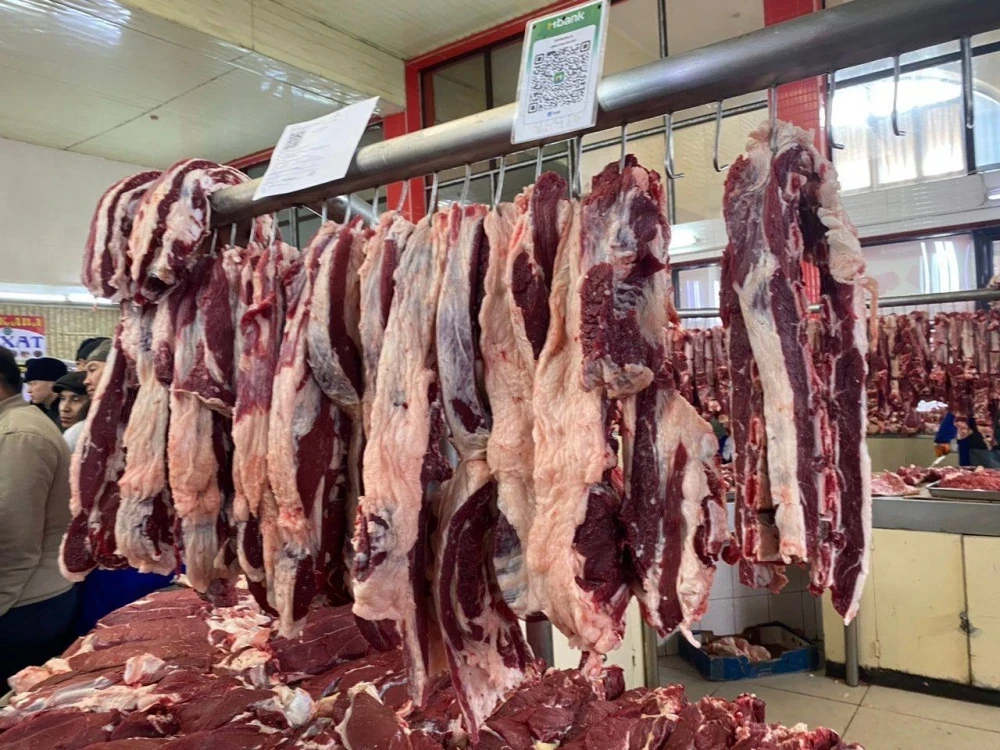
Data from the Antimonopoly Regulation Service under the Ministry of Economy shows that meat prices have risen compared to the previous year. As of January 16, 2025, the retail price of beef ranged from 680 to 720 soms per kilogram, which is 110 soms higher than in the same period of 2024.
Based on information from the National Statistical Committee, average consumer prices for meat increased by 113% throughout 2025 compared to the previous year, which is 1.9% higher than the level of 2024.
Moreover, the ministry notes that after the previous ban on the export of live cattle, prices for beef and lamb stabilized at levels ranging from 650 to 680 soms per kilogram across the country.
The document also mentions internal and external inflationary risks. In 2026, the Ministry of Finance plans to increase salaries for budget employees, which may create additional inflationary pressure on the economy amid slowing growth.
Additionally, starting in 2026, the VAT rate in Russia will increase from 20% to 22%, and in Kazakhstan from 12% to 16%, which may affect prices in these countries. In 2025, Kazakhstan showed GDP growth of 6.5% with annual inflation of 12.3–12.6%. In Russia, however, GDP growth rates decreased to 0.6%, while inflation reached 13.2–14.5%. The increase in food prices in the Russian Federation was about 16.8%.
The document also indicates that global beef prices remain high due to a reduction in livestock numbers in several countries. Forecasts for the next 2–3 years suggest that meat prices may remain high both in international markets and in neighboring countries, including Uzbekistan and Kazakhstan.
In light of the above, the ministry proposes to introduce a temporary ban on the export of live cattle to meet domestic meat needs, reduce dependence on imports, and stabilize prices for socially significant food products such as beef, lamb, horse meat, and goat meat.
It is worth noting that the Ministry of Agriculture had previously imposed a similar ban for six months in August 2025.