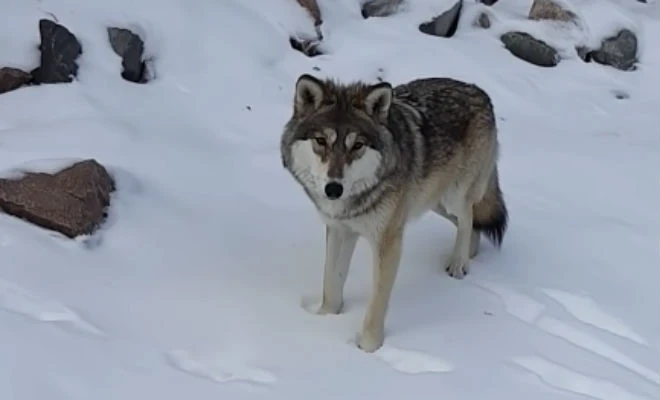
Since the beginning of January, there has been an increase in such incidents in urban areas of the Romagna region, including Rimini and Cesena. Videos are appearing on social media showing wolves wandering the streets; one even captured the moment three wolves were eating a cat.
These sightings have sparked public discussions about the return of wildlife and the associated problems for local residents. The question of coexistence with wildlife is becoming increasingly relevant in other European countries as well, such as France, Germany, and Spain.
On January 6, Rimini Fellini Airport suspended all flights, but the reason was not weather conditions; it was due to a pack of four wolves spotted nearby. Fortunately, only one flight was affected, as the airport operates on a reduced schedule in winter. However, it is much more important to find out why the wolves ended up in this area.
Wildlife and hunting expert Pierre Claudio Arrigoni told local media that the wolves, which have been residing in the area for two years, were likely attracted to the airport by rabbits that had left their usual habitats due to the snow.
Creation of a "wolf emergency service"
Residents of Rimini are also pondering this issue. A special "wolf hotline" has been established in the city to receive calls from concerned citizens.
According to biologist Tania Baskucchi, who works at this service, wolves are attracted to the city by garbage and pet food. She noted that attacks on humans are extremely rare and occur only when wolves lose their fear of people.
However, attacks on domestic animals, such as dogs and goats, happen quite frequently, as they are easy prey. "We recommend keeping pets in secure enclosures at night," she added. "The walls of such enclosures should be slanted at a 45-degree angle to prevent animals from climbing over."
However, such advice is not to everyone's liking.
Residents of Rimini have formed a committee for "wolf emergencies," pointing to the increasing wolf population as a serious problem.
Currently, the wolf population in Italy is estimated to be between 3,000 and 3,500 individuals, and they were on the brink of extinction in the 1970s. "We need to decide who owns our land: wolves or people. Coexistence is impossible," they stated in their appeal.
“We know little about wolves, as they have not been here for over a hundred years. Previously, farmers had shotguns, and there were 'wolf hunters' who were paid for their extermination.”
Discontent has arisen over the authorities' recommendations to keep animals indoors at night or to build safer enclosures outside. "Now we are being convinced that the problem lies with us. We will have to install fences two to three meters high, underground barriers, electric fences, and barbed wire (often prohibited), and keep dogs and cats locked up," they continue in their statement.
“But in the village, dogs are guard animals, not just pets, and cats serve to scare away rodents.”
The benefits of wolves' presence
Despite the increased number of attacks on animals, conservation organizations emphasize the importance of the return of wolves to the ecosystem.
The Rimini branch of WWF noted that the presence of wolves is a "valuable resource." "It restores ecological balance and controls the wild boar population, which has significantly increased," they added.
Simplifying wolf hunting and trapping in EU countries
Meanwhile, local authorities believe that the approach to wolf conservation does not align with broader European trends. Last year, the European Parliament downgraded the wolf's protection status from "strictly protected" to "protected." This will allow member states to manage wolf populations more flexibly to improve coexistence with humans and minimize their impact.
Additionally, it will be easier for authorities to implement measures tailored to local conditions. In Emilia-Romagna, it is noted that the national management plan, in effect since 2002, does not correspond to the changed status of the wolf at the European level.
At the end of the month, local mayors, police chiefs, and forest police will gather to review the strategy for managing wolf populations.