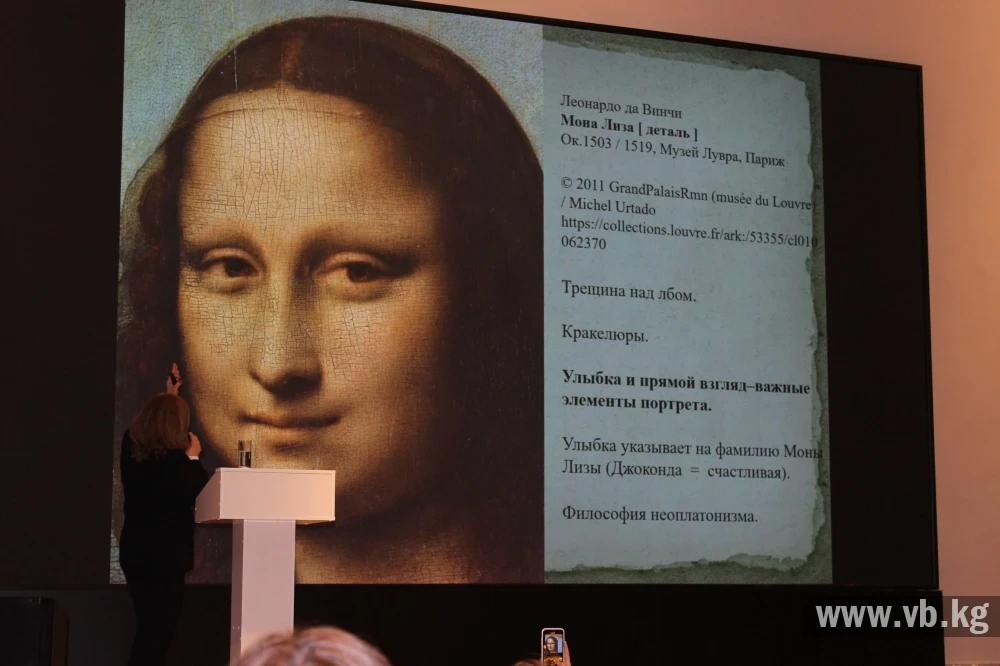
During a lecture held at the National Historical Museum of Kyrgyzstan, art historian Gordana Fai presented the "Mona Lisa" not just as a masterpiece of art, but as a complex cultural phenomenon that has developed over centuries. She conducted an analysis that encompasses the history of portrait painting, the fate of the painting's subject, and the biography of the artist himself, demonstrating how this work of art became a global cultural phenomenon.
Fai posed a question to the audience: "Why do millions of people strive to see her in the Louvre when there are hundreds of other masterpieces there?" This question became the foundation of her lecture.
Exploring the traditions of 15th-century portraits, the art historian noted that at that time, static images predominated, often executed in profile, with minimal visual contact with the viewer.
"A person in such paintings appears closed off, they do not interact with you," Fai explained.
Despite artists beginning to move away from strict profiles by adding turns of the figure and landscapes, the perception remained the same:
"There is no sense that a living person is in front of you."
In this context, the "Mona Lisa" is perceived as a true revolution in portrait painting.
"Leonardo turns the figure towards the viewer, shows her in three-quarters, adds hands. The main thing is that a sense of presence arises. This is no longer just an image, but a real person," she noted.
Fai thoroughly analyzed the composition of the painting, focusing on details that often go unnoticed. Lisa sits in a loggia, her pose is calm, and her hands are neatly folded.
"This stable structure is enlivened by her gaze and smile, creating the feeling that she is here and now," she added.
The art historian also emphasized the importance of the hands, which in the painting cease to be a secondary element:
"They enhance the sense of reality and connect the figure with the space."
Fai then moved on to the painting technique, explaining why the "Mona Lisa" looks different from other works of that time.
"Leonardo uses soft transitions of light and shadow instead of sharp lines. Forms arise from these transitions, not from contours," she emphasized.
This makes the image more "alive" and less rigid. Fai linked this approach to Leonardo's scientific studies:
"He studied vision, light, and atmosphere, understanding how distant objects are perceived less clearly and with changing shades. This he transferred to his painting."
The landscape behind Mona Lisa became one of the most complex details of the painting.
"It is not just a background, but a space constructed according to the laws of perception," she noted.
Fai also pointed out an important nuance:
"The horizon line is higher on one side than on the other, creating an internal tension that the viewer may not be aware of, but feels."
Moreover, thanks to the landscape, Leonardo conveys a sense of air and depth:
"You feel the distance, humidity, and space, which is the result of his observations of nature."
Speaking about the model, Fai restored her biographical details.
"It is believed that this is Lisa Gherardini from Florence, born into a wealthy family and married young. She had several children," she said.
At the time the portrait was painted, she was about 24 years old.
Fai specifically addressed her social status:
"She is not from the aristocracy, but belongs to the affluent urban class."
She also noted an important point:
"Lisa is depicted without jewelry, which is unusual for a woman of her status, as status is usually emphasized by them."
According to Fai, this was a conscious decision by the artist:
"Leonardo removes everything superfluous to focus on the inner image."
She also mentioned common theories about Lisa being in mourning or pregnant and explained why they are not substantiated:
"We do not see any signs that could confirm this. Most likely, it is just an artistic image."
A particular interest was sparked by the analysis of Mona Lisa's smile.
"Her smile is not static. If you look directly at her lips, it almost disappears, but from another angle, it appears," Fai explained.
This is related to how peripheral vision works and how the image is constructed using sfumato.
Next, the art historian spoke about Leonardo and his long process of creating the painting.
"He worked on it for about 15 years and did not deliver it to the client," she noted.
The painting remained with the artist, and he continued to return to it throughout his life, despite many other projects. Fai described this period in detail: returning to Florence after Milan, working on large state commissions, creating religious compositions, and engineering developments.
"He was constantly busy, but he returned to this work," she emphasized.
Fai also talked about Leonardo's move to France, invited by King Francis I, who took the "Mona Lisa" and other paintings with him.
After his death, the painting was purchased and remained in France.
Then began its history outside the workshop.
"It ended up in the royal collection, accessible only to those close to the court," Fai noted.
She also mentioned an unexpected fact:
"At one point, the painting was in Napoleon's private quarters."
The widespread fame of the "Mona Lisa" began to form only in the 19th century.
"French poets and writers began to write about it, creating the image of a mysterious painting," she added.
A key moment was the theft of the painting in 1911.
"A museum worker took it off the wall and carried it out, and it went unnoticed for a long time," Fai said.
The painting was missing for two years, and she described the resonance it caused: "Everyone was talking about it; it was a global sensation."
Famous artists and poets came under suspicion, which only heightened interest in the painting.
When the "Mona Lisa" was found, its popularity increased. "It was shown, discussed, and received like an event," Fai added.
She also talked about the fate of the painting during wars: it was evacuated, transported, and hidden, receiving special protection.
Fai explained why the painting looks different today: "The varnish has darkened, the colors have changed, and we do not see it as Leonardo saw it."
She also drew attention to the size of the painting:
"Today it seems small, but for the 16th century, it was a large portrait, which enhanced the sense of presence."
According to Fai, the influence of the "Mona Lisa" extends far beyond painting: it has influenced artists, literature, cinema, and popular culture. Even the story of its theft has become part of cultural heritage.
In conclusion, she tied everything into a single line:
"It is not one reason, but a combination of innovation, Leonardo's personality, the fate of the painting, the theft, and media attention. This is how a myth is formed."
As a result of the lecture, the "Mona Lisa" transforms from simply "the most famous painting" into a work that possesses deep meaning, formed over more than five hundred years, intertwining art, science, chance, and human attention.