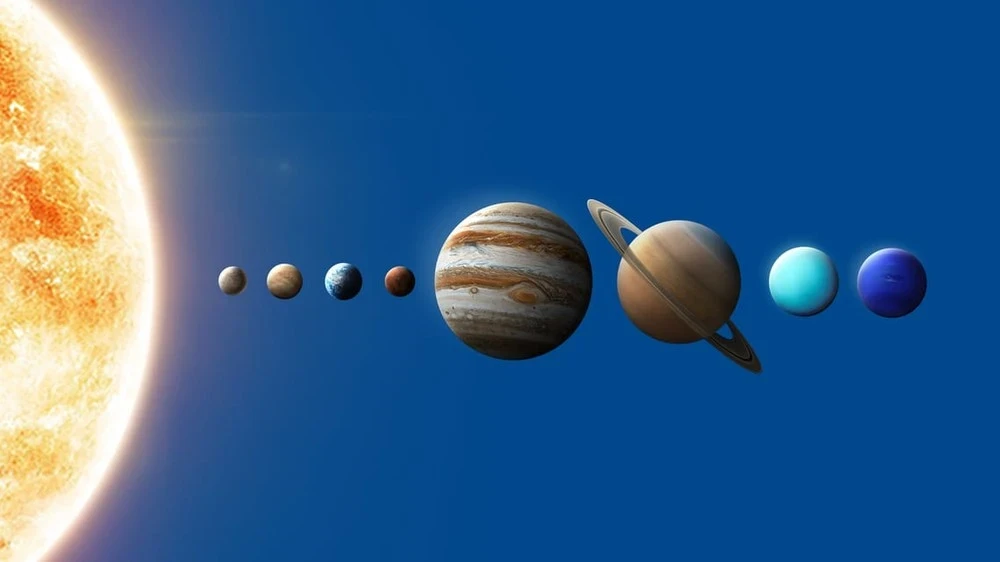
On February 28, 2026, everyone will have the opportunity to witness a unique astronomical event — a parade of six planets.
According to information from NASA, at this time Mercury, Venus, Jupiter, Saturn, Uranus, and Neptune will align in a row. Notably, exactly one year ago, on February 27, 2025, an even rarer phenomenon occurred — seven planets (Mercury, Venus, Mars, Jupiter, Saturn, Uranus, and Neptune) aligned in a single line. The next similar occurrence is expected only in 2040.
This planetary parade happens because all of them move along orbits that lie in the same plane — the ecliptic. Although their distances from the Sun and their speeds vary, sometimes it appears that the celestial bodies are arranged in a straight line. However, it is important to remember that this is just an optical illusion, as in reality, the planets are separated by vast distances of millions and billions of kilometers.
Of the six planets participating in the event, only four — Mercury, Venus, Mars, and Jupiter — can be observed with the naked eye. Observing Uranus and Neptune will require telescopes. Mercury may be difficult to see as it is located low on the horizon.
The best time for observation is about half an hour after sunset. Experts recommend choosing open areas in the western sky with clear weather. Ideally, the planet should be at least a few degrees above the horizon, and preferably 10 degrees or more, as the atmosphere near Earth can distort and absorb the light of celestial objects.
This astronomical phenomenon will be observable from different parts of the world, although the exact dates may vary depending on the location. According to Star Walk, for residents of São Paulo, the best time will be February 25, for Athens, New York, Mexico City, and Tokyo — February 28, for Beijing, Berlin, London, and Mumbai — March 1, and for Reykjavik — March 2.