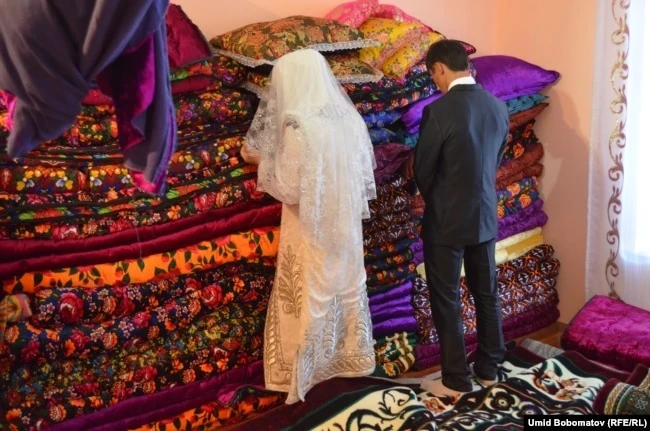
Uzbekistan aims for citizens to marry at a more conscious age. More than a third of marriages in the country are concluded by people who have reached adulthood. The government offers benefits for couples who register their marriage after the age of 21, as this age is considered more suitable for starting a family. Against the backdrop of these initiatives, measures against early marriages are also being introduced, notes Azattyk Asia.
“I LOST A LOT DUE TO EARLY MARRIAGE”
Marhabо, a resident of Tashkent, got married at the age of 17. She claims that this step was her own decision and not the result of family pressure.
“I married my cousin out of love. I graduated from the 11th grade in May, and the wedding took place in August, after which I enrolled in university. My family was against early marriage, but I did not listen to them. Now I understand that they were right, but it is too late. My mother-in-law, although she was my cousin, demanded that I perform all household duties, which was difficult to combine with student life. This caused dissatisfaction on her part. Ten months after the wedding, I had a daughter, and it became even harder for me. I was even forced to take an academic leave,” Marhabо shares in an interview with Azattyk Asia.
Now she is 52 years old and actively speaks out against early marriages, constantly emphasizing to her daughter the importance of marrying at a more mature age.
“I have always told my daughter that I will not allow her to marry at a young age, as I did. Because of early marriage, I lost a lot; I could not enjoy student life like my classmates. After classes, I rushed home. My husband was also studying, and our scholarships did not cover all expenses, so we constantly had to ask our parents for help. Due to stress and early motherhood, I had health problems,” Marhabо shares.
At the end of 2025, Uzbekistan proposed to tighten penalties for de facto marriages with minors and to prohibit unions between relatives up to the fourth degree.
Early marriages, in which one or both parties have not reached adulthood, have long been considered the norm in Uzbekistan. However, the situation has begun to change over the past 15 years. According to official statistics, in 2010, more than 8,000 early marriages were registered in the country, and by 2023, this number had decreased to 68. In the first nine months of 2025, 155 marriages were registered in which the girls' ages ranged from 15 to 17 years.
In 2024, the non-governmental organization Equality Now, which advocates for the rights of women and girls, included Uzbekistan in the list of countries with a problem of early marriages. Although the number of such unions has decreased and stands at 3.4 percent, in the eastern regions, this figure remains at 11 percent.
“The problem remains relevant in some areas, such as the Chirakchin district in the Kashkadarya region, the city of Margilan in the Fergana region, and the Buka district in the Tashkent region, where traditional patriarchal views still have a strong influence,” explains expert Saiyora Khojaeva, director of the Institute of Democracy and Human Rights and a candidate of legal sciences.
Discussing the problem of early marriages in Uzbekistan, specialists point to social pressure as one of the main factors.
“Early marriages negatively affect health and education. According to medical data, the risk of complications during childbirth for girls aged 15–19 is twice as high as for adults. This is because their bodies have not yet completed their development. However, the problem is not limited to personal choice but also to the social environment in which these girls grow up,” notes activist Muazzam Ibrakhimova, a psychologist from the non-governmental organization "Mehrjon," working in Fergana.
Economic Incentives and Legal Measures
Human rights organizations in their recommendations have called on the government of Uzbekistan to implement material incentive strategies to prevent early marriages and ensure girls have the opportunity to continue their education.
Recently, the authorities of Uzbekistan decided to introduce measures to encourage marriages at a more mature age, including economic support and legal mechanisms.
On March 3, President Shavkat Mirziyoyev signed a decree according to which, starting in 2027, young couples who marry after the age of 21 will receive additional benefits. Subsidies and grants for professional development will be increased by one and a half times. Newlyweds may also be exempt from paying state fees when concluding a marriage contract.
At the same time, the authorities are launching a training program for newlyweds. It is reported that by 2030, all couples getting married will undergo free courses titled “Preparing for a Happy Family Life Without Domestic Violence” at special centers.
Until 2019, girls in Uzbekistan could marry at 17, after which a unified marriage age of 18 was established for both men and women. After that, the number of 17-year-old brides decreased by 97 percent in 2020, down to 88 cases across the country.
However, the legislation still allows for respectful reasons to lower the marriage age by one year, such as pregnancy or childbirth. Now, to register a marriage involving minors, it is necessary to apply to local authorities. Previously, parents and relatives obtained permission for their children to marry under various pretexts; now the authorities intend to establish a clear list of grounds for lowering the marriage age, as reported by Nodira Hakimova, deputy head of the presidential administration for reforms in the judicial system.
“From now on, such commonly accepted reasons in society as ‘grandma wants it’ or ‘the groom needs to take the bride abroad’ will not be sufficient for marrying off underage girls,” the official stated.
She also reminded that there is an article in the Code of Administrative Responsibility of Uzbekistan regarding violations of marriage age legislation, which provides for penalties for men marrying minors, their parents, and those conducting religious ceremonies, but not for intermediaries. Now the scope of this article will be expanded: it will apply to individuals who encouraged and promoted the marriage of minors.
The state also plans to introduce responsibility for concealing early marriages and pregnancies of underage girls.
The Reasons for Change are Obvious
The main reasons why Tashkent decided to revise the legislation are clear.
According to statistics, about 40 percent of marriages in the country are concluded between people aged 18–19. Newlyweds at this age usually lack financial independence and education. Many of them live with older generations, which often leads to conflicts and domestic violence.
Uzbekistan wants to reduce the number of marriages at a young age and, consequently, decrease the number of divorces. According to official data, about 30 percent of divorces occur among couples under 30 years old.
Traditional values remain strong in densely populated and rural areas, where relatives make decisions for girls.
“I married early and suffered a lot in that marriage. I divorced and raised two children on my own. I did not want my only daughter to face the same fate,” shares 45-year-old Gulnoza from Bukhara.
However, as the woman admits, family circumstances forced her to marry off her daughter immediately after she reached adulthood.
“The father of my children works in Russia and does not participate in their lives, and I have been working in Turkey for over ten years. When I left, the children were small, and I could not take them with me. I left them with relatives and constantly sent money. As soon as my daughter turned 16, my relatives began to persuade me to marry her off. They said, ‘Your daughter has grown up, boys are looking at her, we need to marry her off so she doesn’t bring shame to the family.’ If I had the opportunity to live and work at home, I would have sent my daughter to study. When a good family from our village offered to propose, I unfortunately agreed, as my relatives did not want my daughter to remain under their supervision,” the woman explains.
In Uzbekistan, as in other Central Asian countries, the minimum age for marriage for men and women is 18 years. In exceptional cases, such as if a girl is pregnant, the marriage age can be lowered to 17 years.
“Money Alone Will Not Solve the Problem”
Saiyora Khojaeva, director of the Institute of Democracy and Human Rights, welcomes the authorities' initiative to encourage marriages at a more mature age. However, she emphasizes that the problem cannot be solved solely through financial benefits.
“I searched for examples of financial incentives in international practice but found nothing similar. This indicates that both the state and the country's leadership are interested in solving this problem. According to studies by the World Health Organization, girls in Central Asia reach adulthood at about 19 years, while boys do so at 21. Financial incentives may attract young people, but they are not enough to improve the legal culture. The legal culture must develop through education,” Khojaeva notes.
Psychologist Muazzam Ibrakhimova shares the same opinion.
“Preventing early marriages cannot be achieved with money alone. If a girl is given the opportunity to receive an education and become financially independent, she will not rush to marry. In societies with high educational opportunities, the number of early marriages decreases naturally. The most effective solution would be to ensure access to education for girls. Research shows that the number of early marriages sharply declines in places where girls receive pre-university education. Therefore, comprehensive measures need to be implemented, such as education grants and vocational training programs for girls, as well as awareness campaigns for parents,” the expert asserts.
Some of the measures being taken are already being implemented. Starting next academic year, female students who leave university to have a child will be given the opportunity to return and continue their education, receiving a “second chance” at higher education. Additional conditions for raising a child and mastering the curriculum are also promised.
Marhabо from Tashkent supports the measures being taken by the government. She believes that a girl should be emotionally mature and able to support herself by the time she gets married.
“I have always told my daughter: first get an education, find a job, and create financial independence, and then think about marriage. I am glad she listened to me,” Marhabо concludes.
The post In Uzbekistan, despite traditions, they decided to encourage mature marriages first appeared on K-News.