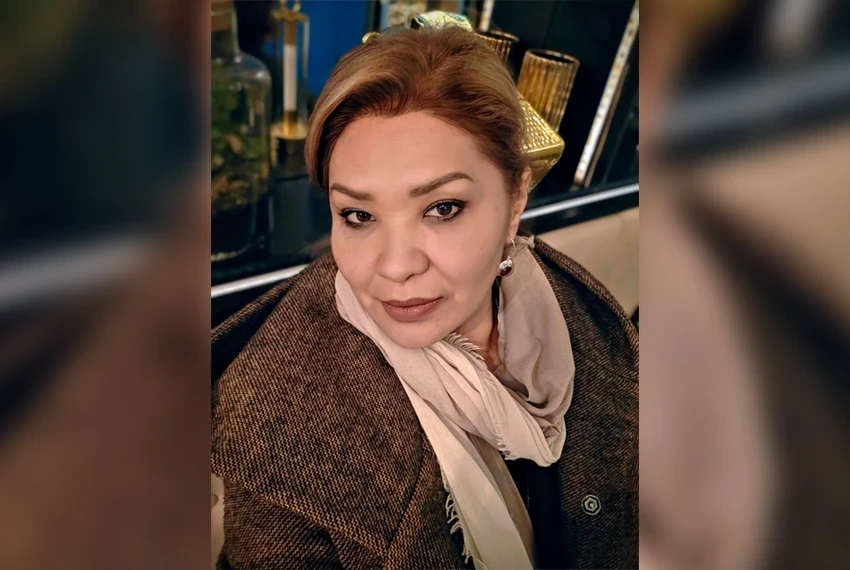
Suündük was born on September 14, 1968, in the village of Tilekmat, located in the Jeti-Oguz district of the Issyk-Kul region. She was the seventh child in a family of ten, where eight children were girls and only two were boys. After completing her secondary education, Suündük continued her studies at a pedagogical institute in Karakol, where she graduated from the mathematics faculty.
“I worked as a teacher for only one year, then got married and focused on raising children, and later found another job,” she recounted about her life. In 1993, Suündük married Janaly Akmatov, and they had six children and four grandchildren: “Thank God, we have a good life. My husband, a journalist by profession, works at the local museum, which inspires him to appreciate Kyrgyz traditions and support me in my craft.”
Since childhood, Suündük has been interested in wool processing and making shyrdaks under her mother’s guidance. After retiring and when her children grew up, she participated in a tourism seminar, which inspired her to achieve new things: “My daughter-in-law signed up for a seminar in the Ton district but couldn’t go, so I replaced her. I was amazed by what I saw and wanted to create something similar.”
At the seminar, she met other craftswomen from the Jeti-Oguz district, and together they formed a group to start making felt products. They quickly mastered the stitching of shyrdaks and felting wool, as they already had experience in producing Kyrgyz items. One of the group members became a sponsor and helped with the purchase of materials.
Today, products that once seemed forgotten are being updated in a modern style, with wall hangings and small shyrdak rugs being particularly popular among tourists. During the summer, Suündük hosts guests at the Kök-Jaiyk pasture, where she has three yurts.
“When my children grew up, I worked at Gazprom and retired at 50. My sister started hosting tourists in her yurt at the Kök-Jaiyk pasture, and I decided to follow her example. I contacted the forestry department to request land for rent, and they agreed. At first, we had one yurt, and now we have three,” she shares about her venture.
At the pasture, Suündük welcomes not only local but also foreign tourists, offering them Kyrgyz dishes. “Tourists especially love kuurdak. We also offer ayran and kaymak, and they highly appreciate our treats,” she adds. A traditional Kyrgyz dish is “kölöngön talqan,” which is prepared with horse fat and is very popular with children.
Due to restrictions on livestock grazing at the Kök-Jaiyk pasture, to ensure the quality of her products, Suündük orders milk from the Kochkor district for making kumys, which she prepares in a wooden chalek inherited from her mother-in-law.
Suündük urges guests to treat nature with care and follow the rules: “We always remind vacationers not to make fires and not to leave trash because preserving nature is our common duty.” She also sells her products to tourists, who willingly buy small felt items, such as woolen slippers.
Despite the fact that many young people show little interest in crafts and prefer ready-made products, Suündük believes that her work brings not only income but also spiritual satisfaction. “Every mother should pass on Kyrgyz art to her daughters and daughters-in-law. I teach my daughter and daughter-in-law how to make felt products, and I hope they will continue our work,” she concludes.