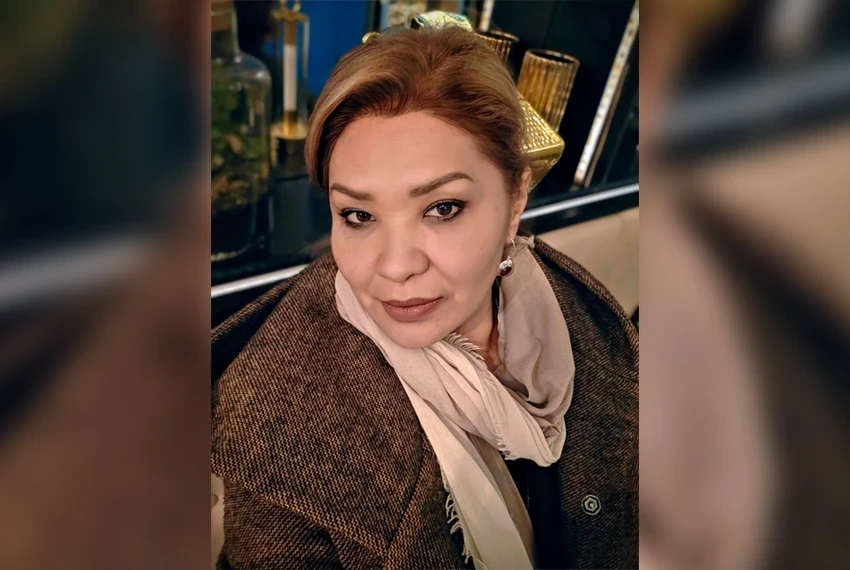
She was born on February 12, 1961, in the village of Orgochor in the same district. After graduating from the Y. Gagarin Secondary School in 1977, Nurilya trained as an accountant at one of the educational institutions in the capital, Bishkek. In 1980, she got married and moved to Kyzyl-Suu, where she raises three children—two daughters and a son—with her husband.
From a young age, Nurilya was passionate about handicrafts, inheriting this craft from her mother, and after her marriage, she learned many skills from her mother-in-law.
“Before the collapse of the Soviet Union, I worked as an accountant at a state farm. However, after its collapse and the closure of the state farm, when my youngest daughter was born, I stayed at home. During this time, I immersed myself in my passion for handicrafts and made it my main activity,” she shared.
Initially, Nurilya started making chair mats, and then she switched to sewing shyrdaks.
According to her, creating one shyrdak takes up to a week. “There is a lot of work in our village: milking cows, doing household chores. Therefore, I engage in handicrafts in my free time. If I could work all day, I would finish one shyrdak in two days. My husband always supports me. Usually, I sew in the evenings, and if there isn’t enough light, he sets up additional lighting,” the craftswoman said.
She noted that engaging in handicrafts is especially beneficial for health in adulthood. “When I do physical labor, my health improves. Many people now spend time on their phones, but it is much better to do something useful and develop one’s imagination,” she added.
Nurilya is not alone in her craft; she works alongside other women from her village.
According to her, they work as a team: some cut patterns, others quilt, some sew edges, and there are those responsible for sales.
The products of local craftswomen find buyers among both local residents and foreign tourists.
“Tourists like natural items. They choose products without dyes, using pure natural colors. The most popular items are mats and small shyrdaks that are easy to carry. Working with tourists is very exciting: we conduct master classes and explain the process of creating the products. They are often surprised. Communicating with them lifts the mood and makes the day interesting,” Nurilya said.
Additionally, she introduces guests to Kyrgyz traditions. “I am often asked to show how to wrap a child in a beshik (Kyrgyz cradle). I demonstrate this ritual. Tourists are very interested: after we lay a hypothetical baby in the beshik, they start rocking it themselves and sing lullabies in their languages. They really like our cradle and songs,” she added.
According to Nurilya, the price of the products varies depending on the size. Seat cushions cost from 1500 soms, shyrdaks range from 16,000 to 20,000 soms, and panels start from 4500 soms and up.
She also noted that the income from handicrafts allows her to travel. Together with her colleagues, she visited Turkey, where she learned about local crafts.
“I consider it an achievement that thanks to my work, I have been able to visit various corners of the country and beyond, represent our products, conduct master classes, and attract interest in Kyrgyz national crafts. Our work inspires other craftswomen. I am pleased when people come to us and say, ‘I also want to engage in crafts.’ We share tips on materials, and they start doing Kyrgyz handicrafts,” Akylbekova said.
In the future, she and her colleagues plan to develop their craft, create higher quality and more interesting panels, and continue sharing knowledge with those who want to engage in handicrafts.
“It is important to engage in manual labor instead of mindlessly spending time on phones. In the past, mothers made two shyrdaks for each child. Now, they don’t even make one. Unfortunately, some do not appreciate the shyrdak that their mother made with such effort: it lies outside, dirty with coal and manure. This is very sad. We must respect manual work, cherish the craftsmanship of mothers, and pass it on to future generations. When we prepare a dowry for girls, it would be wonderful to gift them shyrdaks made by hand,” she emphasized.
In addition to handicrafts, Nurilya's family is engaged in agriculture.
Their family owns 4.5 hectares of an apple orchard, where they grow strawberries and raspberries together with her husband and children, as well as make jam and sell the surplus.
“Strawberries bear fruit until the snow falls. A kilogram of strawberries sells for 180 soms, a small bucket of raspberries for 400-500 soms, and apples for 40-60 soms per kilogram. Our products are bought by local residents and resellers who then sell them in Kazakhstan,” the craftswoman concluded.
Objects
Satellite
⛶