The preservation of balance in the payment position is achieved through remittances and a significant increase in gold and foreign exchange reserves.
As of the end of 2025, the economy of Kyrgyzstan demonstrated a real growth rate of 11.1%. Despite a trade deficit of $10.1 billion, remittances and a sharp increase in gold and foreign exchange reserves helped maintain the payment position in a stable state, as noted by the leading analyst of Kursiv Research, Alisher Karimov.
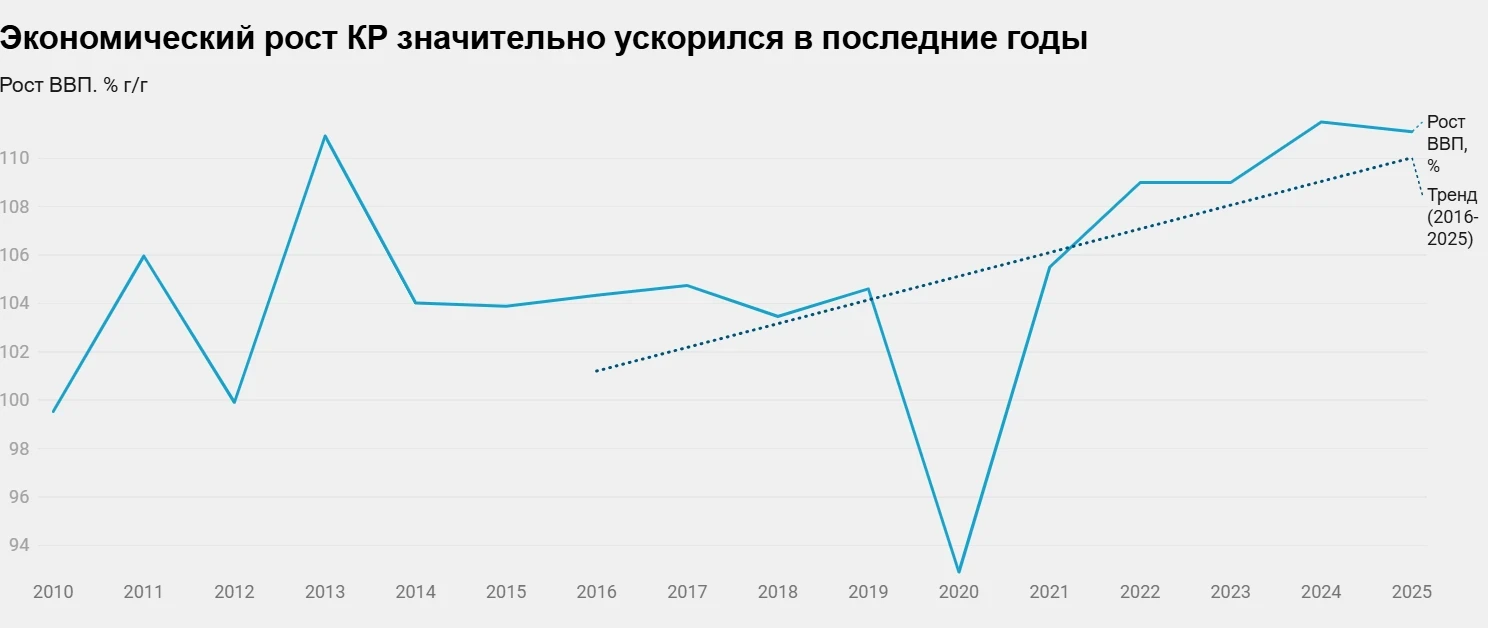
The economic growth of the Kyrgyz Republic (KR) continues to show high rates, expecting an average of 9.2% per year from 2021 to 2025. According to preliminary estimates from the National Statistical Committee, by 2025, the country's GDP may reach nearly 2.0 trillion soms ($22.6 billion), which is 13 times less than the corresponding figure for Kazakhstan. The high growth of recent years in KR is partially explained by the low base effect.
In recent years, Kyrgyzstan has become a strategically located region, benefiting from the influx of relocators (up to 340,000 in 2022-2023) and increased demand for labor migrants in Russia. According to World Bank data, from 2010 to 2024, the volume of remittances to Kyrgyzstan will amount to about 28.1% of GDP.
In the first quarter of 2025, the number of registered labor migrants from KR in Russia increased by 6.6% — from 352,000 in January to 377,000 in March, according to estimates from the International Organization for Migration. This means that every eighth working-age citizen of Kyrgyzstan worked in Russia.
The volume of remittances to KR for the first nine months of 2025 increased by 23.1% compared to the same period last year, which helped balance the payment balance along with income from gray re-exports. The gold market also contributed to the growth of international reserves of the National Bank of KR (NB KR).
Key sectors of the economy
The services sector accounted for 51.2% of Kyrgyzstan's GDP in 2025, and last year this sector showed steady growth, increasing added value by 10.9% year-on-year, while the volume of market services reached 2.9 trillion soms (+14.8% y/y).
The main driver of services remains trade, which accounts for 76.3% of all services. Trade turnover increased by 17.8%, reaching 2.2 trillion soms. The financial sector and insurance ranked second with a volume of 290.7 billion soms (9.9% of all services) and a growth of 0.8% y/y. Logistics (+6.5%, to 105.3 billion soms) and HoReCa (+14.3%, to 73.3 billion soms) also showed positive dynamics.
The dynamic development of the services sector is largely related to the real increase in household incomes. On average, nominal wages increased by 18.9%, while inflation over the year was 9.4%. Consumer activity is supported by a stable flow of remittances and consumer lending.
The manufacturing industry ranks second in significance in the economy (13.7% of GDP) and demonstrates a production growth rate of 9.8%. Three key sectors — metallurgy, the food industry (including beverages and tobacco), and the production of rubber and plastic products — account for 90% of all processing. Metallurgy occupies the main share (62.2% of processing), where a slight growth was recorded (+0.2% IFO). Although statistics do not provide data on specific metals, it can be assumed that a significant portion of production consists of gold.
Growth in the food industry was 30.1%, associated with an increase in the production of non-alcoholic beverages (1.6 times), pasta (+41.8%), and distilled alcoholic beverages (+11.4%). The production of rubber and plastic products increased by 35.7%, mainly due to construction materials (+36.6%), which is particularly relevant in the context of a construction boom in the country.
The construction sector, which accounts for 8.7% of GDP, demonstrates growth rates of over 20% for the second consecutive year, thanks to large state projects in transport infrastructure, energy, and housing construction.
The most notable project is the construction of the Kambarata HPP-1, one of the largest hydropower plants in Central Asia. Transport infrastructures are also actively developing, including new roads and several interchanges, overpasses, and tunnels through mountain passes. In December 2025, the construction of the China-Kyrgyzstan-Uzbekistan railway began. Housing construction also developed actively, with the commissioning of 15,100 housing units totaling 1.8 million square meters (+15.7% y/y).
The mining sector accounts for only 2.1% of GDP but shows significant growth (+14.2% IFO) due to increased extraction of metallic ores (+21.6%), coal (+10.3%), and other minerals (+40.2%).
Investment in fixed capital
Investment in fixed capital (IFC) continues to grow rapidly. In 2025, the volume of investments reached 374.6 billion soms (19.0% of GDP), increasing by 18.4% in real terms.
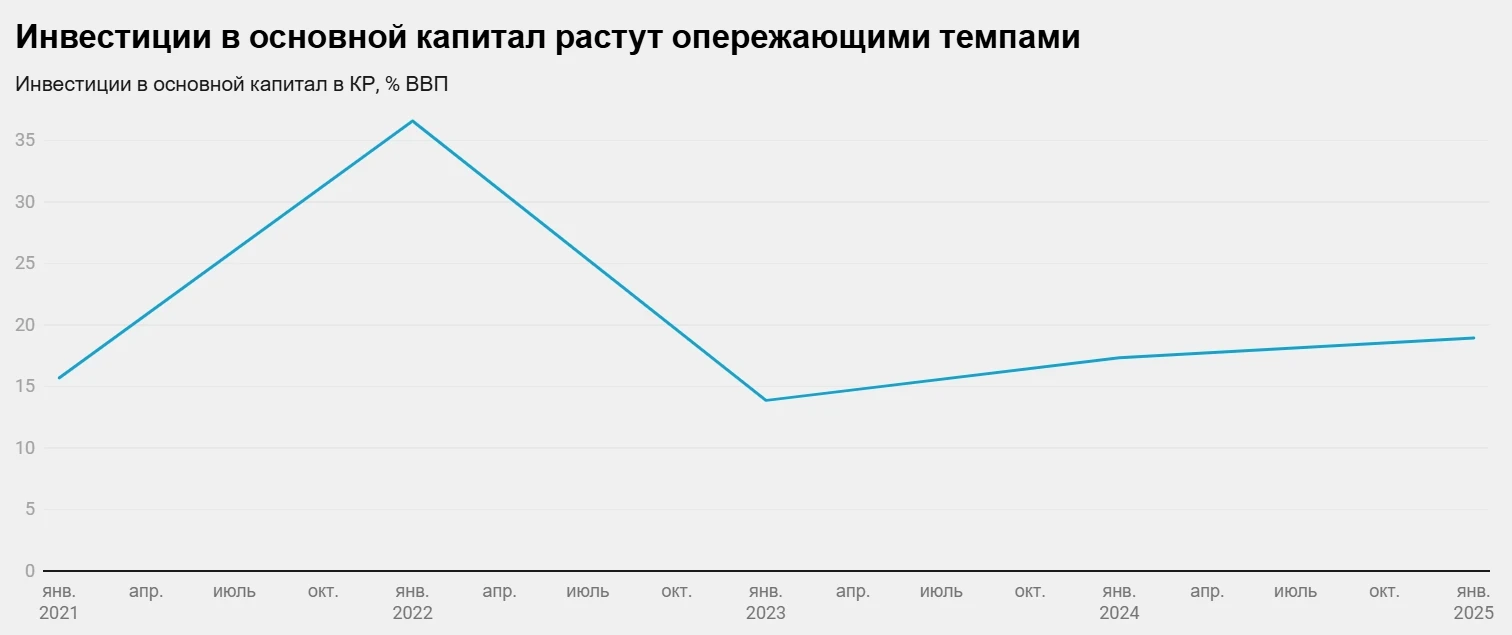
The structure of IFC has changed slightly: if in 2020-2024 the mining sector received 18-22% of all IFC, in 2025 its share was only 7.8%. At the same time, there is significant growth in the share of transport and logistics — from 8-12% to 17.5%. This is related to the completion of the investment cycle in gold mining and precious metals production, which form the basis of KR's exports. Last year, underground mining and processing of enrichment waste began at Kumtor, the largest gold ore deposit in Kyrgyzstan.
At the same time, the sources of financing for IFC have changed: the share of domestic investments decreased from 86.0% in 2024 to 78.9% in 2025, which is associated with a decrease in business investment activity. Nevertheless, two other major domestic sources of IFC increased: the republican budget (1.4 times) and household funds (+3.8%). The share of external sources also increased to 21.1% (14.0% in 2024), with this category seeing an increase in foreign loans (2.3 times) and foreign direct investment (1.7 times).
Inflation and monetary policy
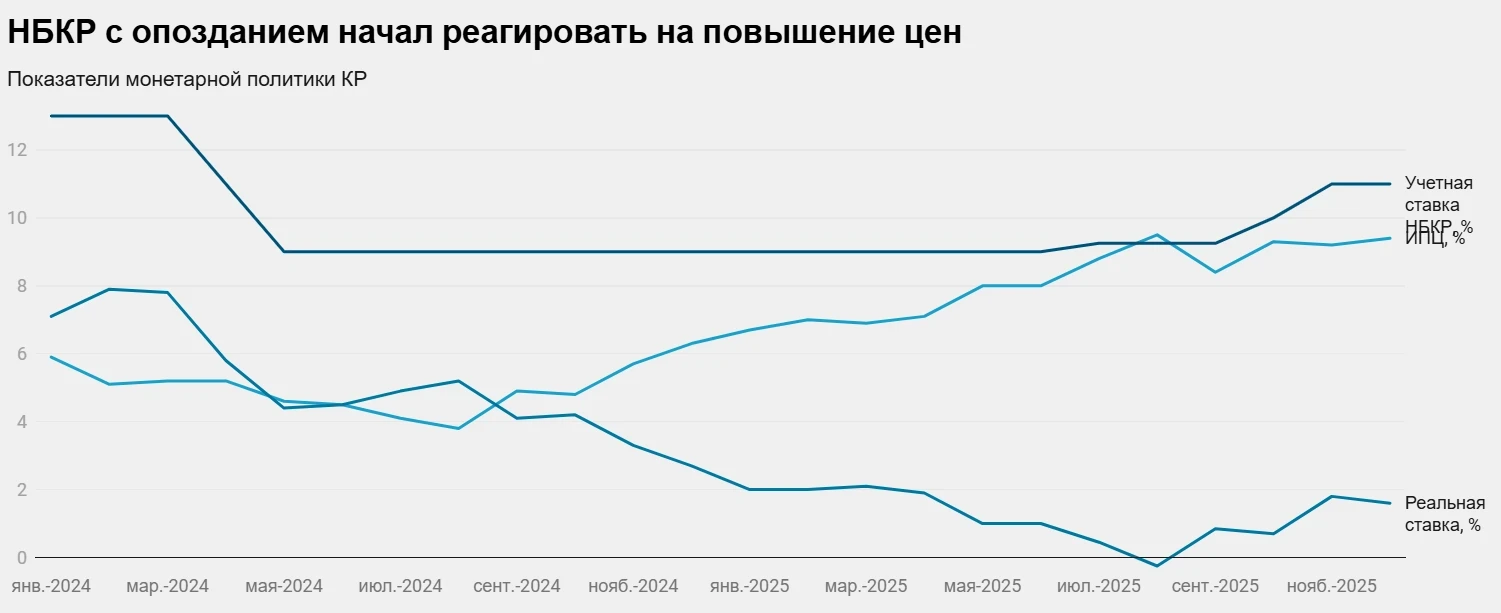
In 2025, the monetary policy of NB KR was aimed at maintaining price stability in the context of increased domestic demand and volatility in global markets. The medium-term inflation target was set at 5-7%.
In the first half of 2025, the regulator kept the interest rate at 9.0%, despite inflation exceeding the upper limit by 0.1 percentage points in April. The main factors for price growth were increased household incomes and remittances from abroad. The situation worsened after the planned tariff increase in May. In July, NB KR raised the rate by 0.25 percentage points, leading to a negative real rate (–0.25% in August 2025). Subsequent rate increases to 10% in October and 11% in November somewhat tightened monetary conditions, but the inflationary background remained high.
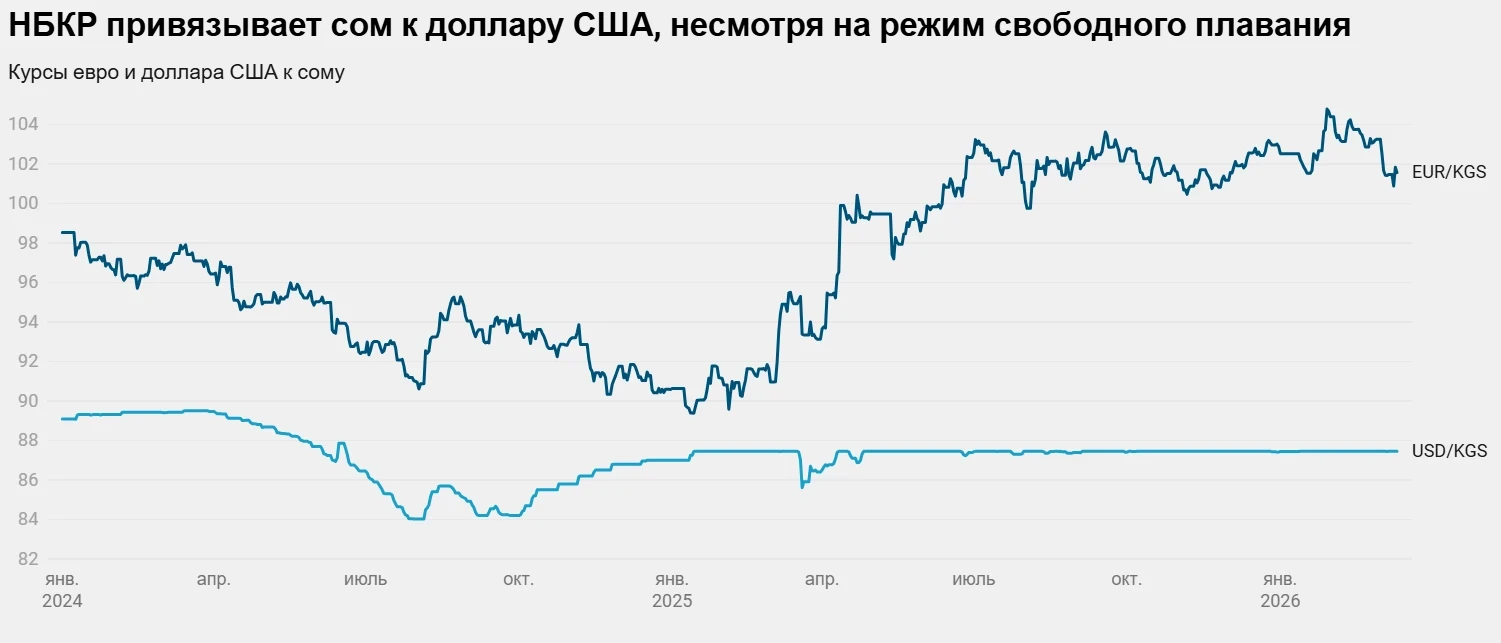
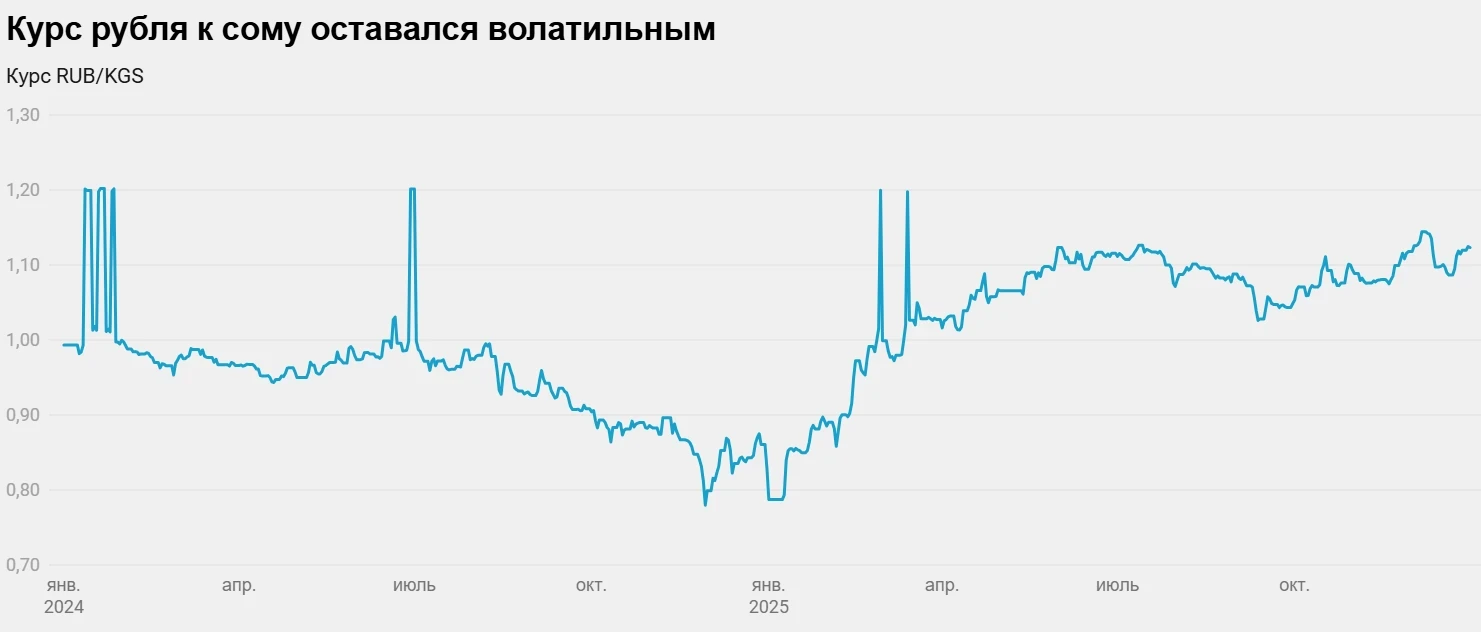
External factors had a negligible impact: in 2025, the exchange rate of the som against the dollar remained almost unchanged. Since the introduction of the som in 1993, NB KR has implemented a floating exchange rate regime, but the central bank regularly conducts currency interventions to prevent sharp fluctuations. In 2025, NB KR intervened in currency trading eight times, with a total volume of interventions amounting to $853 million (or 9.9% of NB KR's gold and foreign exchange reserves). The last operation was a net sale of currency amounting to $179.5 million.
The trade balance continues to be in deficit: imports ($13.0 billion) significantly exceed exports ($2.9 billion) for 2025. At the same time, exports decreased by 44.5% y/y, while imports increased by 3.9%.
The main factor in the deterioration of the trade balance was a 72.8% decrease in gold exports, down to $682.9 million ($2.5 billion in 2024). At the same time, exports of ores and concentrates of precious metals increased (+95.5%, to $413.6 million). By country, the largest volume of exports went to Switzerland (gold — $437.8 million), China (ores and concentrates of precious metals — $89.9 million), Russia (clothing — $80.6 million, fruits and nuts — $35.6 million), and Uzbekistan (ores and concentrates of precious metals — $175.1 million). Imports mainly increased for consumer and industrial goods, except for meat (–5.0%), clothing (–27.7%), chocolate (–2.1%), and sugar (–26.3%).
As of the end of 2025, the trade balance deficit amounted to $10.1 billion ($7.3 billion in 2024), or 44.3% of GDP. Part of the deficit is compensated by remittances from labor migrants, the volume of which increased by 23.1% y/y (to $2.5 billion), equivalent to 17.8% of GDP, which is below the average level for 2020-2024 (25.5%).
An analysis of the balance of payments shows that in the first nine months of 2025, $3.9 billion entered the country under the "errors and omissions" item, reflecting unaccounted capital flows and shadow exports. Products from third countries are often resold through Kyrgyzstan to the EAEU with understated value or incorrect declaration to evade taxes. The share of gray exports can reach up to 40% of trade turnover. This helped keep the deficit of the balance of payments at $663 million ($344.4 million for 9M2024). However, the Federal Customs Service of Russia is developing a system for confirming the expected delivery of goods (SPOT) to combat gray imports, which may limit these flows in the future. The implementation of SPOT is planned to be tested from April and fully implemented from July 2026.
Considering the significant influx of currency in 9M2025 from both official ($2.5 billion) and unaccounted ($3.9 billion) sources, Kyrgyzstan largely covers its trade deficit. Thanks to rising gold prices, NB KR can conduct interventions and increase reserves. According to the World Gold Council, Kyrgyzstan ranks 15th in the world in terms of gold purchases by central banks. Gold prices have risen, leading to an increase in the country's gold and foreign exchange reserves by 69.1% y/y, amounting to $8.6 billion by the end of 2025.
Fiscal policy and public debt
In 2025, the state budget was executed with a surplus of 50.2 billion soms (2.5% of GDP). Total revenues increased by 44.9% y/y, reaching 673.2 billion soms. The main sources of revenue were VAT (24.4% of total revenues), corporate income tax (21.9%), and taxes on international trade (13.0%). The volume of non-tax payments amounted to 189.5 million soms (28.1%), increasing by 86.8% y/y.
The expenditure part of the budget increased by 45.9% (to 623 billion soms) and can be conditionally divided into three areas: social and cultural expenditures (48.1%, 212.3 billion soms), defense and security (27.1%, 119.7 billion), and government services in the economic sphere (24.3%, 107.2 billion).
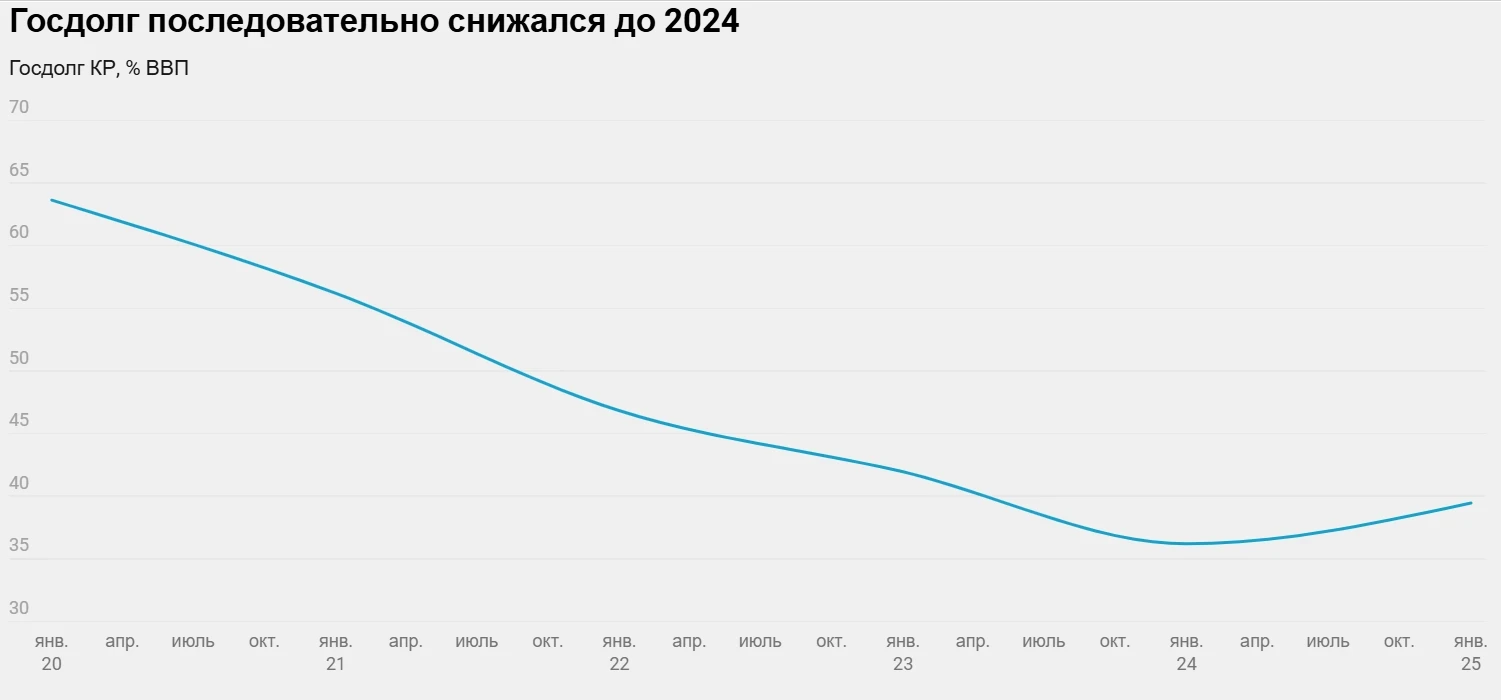
By the end of 2025, the public debt amounted to 779.8 billion soms (about $8.9 billion), of which 59.9% ($5.3 billion) consists of external borrowings. Almost half of the external debt consists of loans from international organizations such as the World Bank, the Asian Development Bank, and the IMF. The share of bilateral concessional loans accounts for a third of the external debt (for example, from the Export-Import Bank of China, the Japan International Cooperation Agency, and the Saudi Fund for Development).
The fiscal position of KR is strengthening due to favorable external and internal conditions, and the structure of the debt (high share of concessional loans from international organizations) is quite stable in the long term.
Forecasts for 2026
The Eurasian Development Bank (EDB) forecasts that a high level of consumer activity will support economic growth at 9.5% in 2026, which is slightly lower than last year's figures. Other organizations, such as the IMF and the World Bank, expect growth in the range of 5.3-5.5%.
IMF analysts note that the re-export effect in Russia may weaken, and increased sanctions against Russia may lead to a decrease in remittances. They also point to the possibility of an increase in the deficit in the event of rising imports of equipment for infrastructure projects. A further stress for the KR economy could be a decline in gold prices amid rising energy prices. Over the past five years, nominal GDP per capita has nearly doubled, reaching $2,800 by the end of 2025. The unemployment rate decreased from 5.3% to 3.7%. According to the National Development Program of KR until 2030, the government sets ambitious goals: to increase GDP per capita to $4,000-4,500 and the total volume of the economy to $30 billion, which implies a one-third growth compared to the current level.
photo www