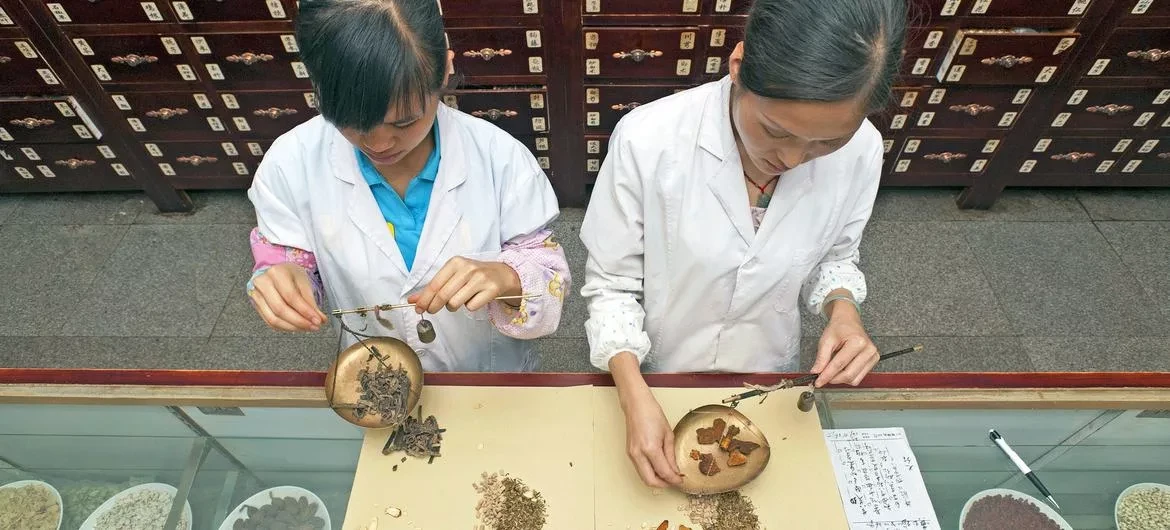
Many of us remember how grandmothers used tea with raspberries and mustard plasters to treat coughs, believing in the healing properties of herbs. The World Health Organization calls for renewed attention to these traditional knowledge systems that are passed down from generation to generation. According to WHO, 90% of participating countries (170 out of 194) report that between 40% and 90% of their populations resort to traditional medicine methods.
Global Summit in New Delhi
The second WHO Global Summit on Traditional Medicine started on December 17 in New Delhi, in collaboration with the Government of India. The event features ministers, scientists, indigenous leaders, and practitioners from over 100 countries.
The forum will serve as a platform for announcing new scientific initiatives and commitments aimed at accelerating the implementation of the WHO Global Strategy on Traditional Medicine for 2025-2034. The focus will be on strengthening the evidence base, improving regulation, integrating into health systems, and engaging communities.
Values of Traditional Medicine
Traditional medicine methods have a long history predating modern biomedicine and continue to evolve. For many people, it is an accessible and familiar way to receive medical care. Some choose traditional methods even when they have access to modern medicine, preferring more "natural" approaches to health care.
WHO combines ancient wisdom with modern scientific achievements
WHO Director-General Tedros Adhanom Ghebreyesus noted: “We aim to combine knowledge accumulated over millennia with the capabilities of modern science and technology to achieve universal access to health services. The use of innovative solutions, including artificial intelligence and genomic technologies, will unlock the potential of traditional medicine and provide safe and effective health solutions for every community.”
Scientific Aspects
Given the increasing challenges for health systems, around 4.6 billion people worldwide lack access to essential health services, and more than 2 billion face financial difficulties in obtaining them.
Integrating traditional medicine into health care is key to expanding access to affordable services and promoting universal coverage. This approach not only saves costs but also contributes to prevention and health promotion, which can lead to more rational use of antibiotics.
Successful integration requires a solid scientific foundation, the establishment of global quality and safety standards, and effective regulatory mechanisms. WHO Chief Scientist Soumya Swaminathan emphasized: “It is necessary to apply the same scientific rigor to both biomedical methods and traditional medicine, while respecting biodiversity and cultural specifics.” Closer collaboration and new technologies, such as artificial intelligence and systems biology, have the potential to change approaches to studying and utilizing traditional medicine.
Innovative Directions
Traditional medicine is the foundation of growing global industries, including the production of medicinal plants. Most traditional medical products and more than half of biomedical drugs are made from natural resources, which are a crucial source for developing new medications.
Indigenous peoples conserve about 40% of the world's biodiversity, even though they make up only 6% of the planet's population. Supporting traditional medicine requires consideration of the rights of indigenous peoples and principles of fair trade.
Creation of a Global Library
Despite the widespread use of traditional medicine and its significance for the conservation of natural resources, less than 1% of global health funding is directed towards research in this area. In response to the demands of heads of state expressed at the G20 and BRICS meetings in 2023, WHO is launching the first-of-its-kind Global Library of Traditional Medicine. The library includes over 1.6 million publications covering research, policy, and regulation in this field.
Supporting traditional medicine is a task based on evidence, ethics, and care for nature
The Global Library also provides equal access to peer-reviewed materials for institutions in low-income countries through the Research4Life initiative, helps countries document traditional medicine practices while considering intellectual property protection, and develops scientific capacity to stimulate innovation.
“Supporting traditional medicine is a task based on evidence, ethics, and care for nature,” emphasized Shyama Kuruvilla, Acting Director of the WHO Global Centre for Traditional Medicine. “The Global Summit creates the opportunities and partnerships necessary for traditional medicine to make a meaningful contribution to the well-being of humanity and our planet.”