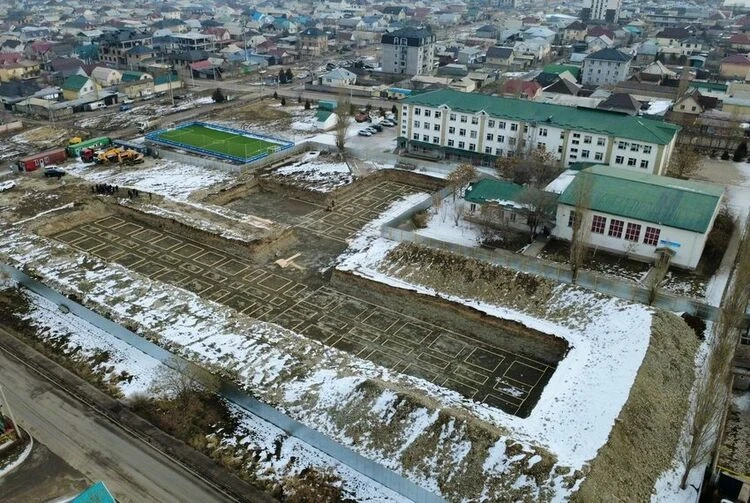
The educational institution continues to operate in this building, located at: 15 Y. Gagarin Street, and provides education to students.
The construction of the building began in 1871 with the involvement of European craftsmen, which allowed for the realization of an architectural style characteristic of Europe. Nearby, there is a small one-story structure.
According to the college administration, the large house was inhabited by the owners, while the small building was used for the needs of the servants. Complete information about this object can be found in the Almaty archive.
This educational institution has a rich history; at different times, outstanding figures of Kyrgyzstan studied here, such as Hero of the Soviet Union Usenbekov Kalynur Usunbekovich, Lieutenant General and former Chairman of the Veterans Council of the Kyrgyz Republic, Academician of the USSR Academy of Sciences Jumagul Alyshpaevich Alyshpaev, as well as Professor Joldosh Jusaevich Jusaev and many other well-known party leaders.
The architectural monuments of the college, built from Tien Shan fir, were erected in 1878 and 1908. These buildings hold memories of significant figures such as Kasym Tynystanov, Khusein Karasaev, Nagima Aitmatova, and Bubuyina Oruzbaeva, who later became renowned figures in science and culture. In the early 20th century, these premises housed male and female native gymnasiums, but over time, the need for more qualified specialists arose, leading to the establishment of a pedagogical technical school based on the gymnasiums in 1930.
A memorial plaque is installed on the building dedicated to the Hungarian orientalist and zoologist György Almasy (1867–1933), who lived in this house in 1906 and studied Lake Issyk-Kul. Almasy discovered new bird species and played an important role in introducing the epic "Manas" to Western audiences.
György Almasy made two expeditions to Kyrgyzstan in the early 20th century, in 1900 and 1906. His letters contain memories of travels through Central Asia, as well as photographs and drawings illustrating the life and customs of the Kyrgyz of that time. In his book "My Travels in Central Asia," he detailed the eastern regions of Issyk-Kul and Tien Shan. Almasy also translated and published an excerpt from the epic "Manas" in German, which contributed to its popularization in Europe.