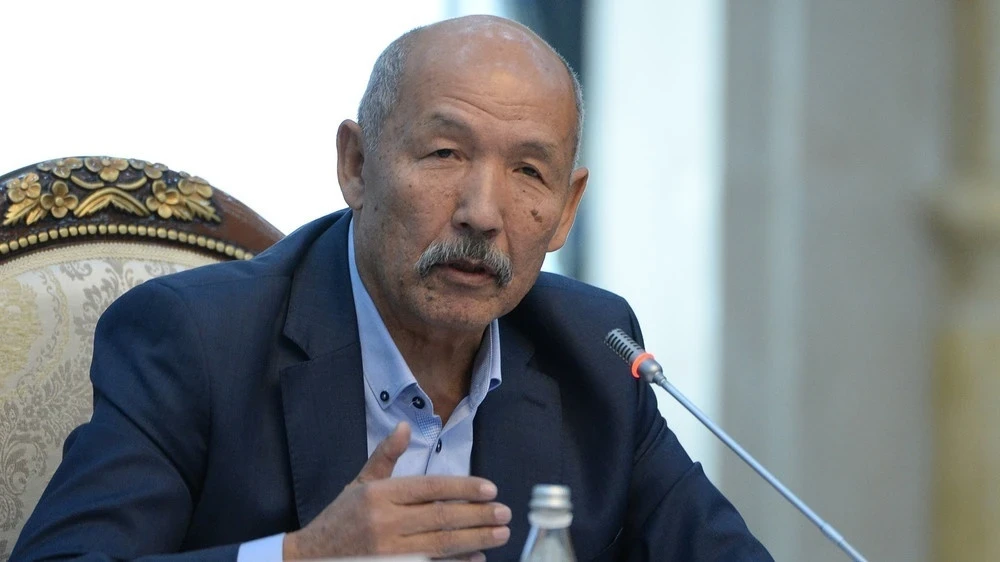
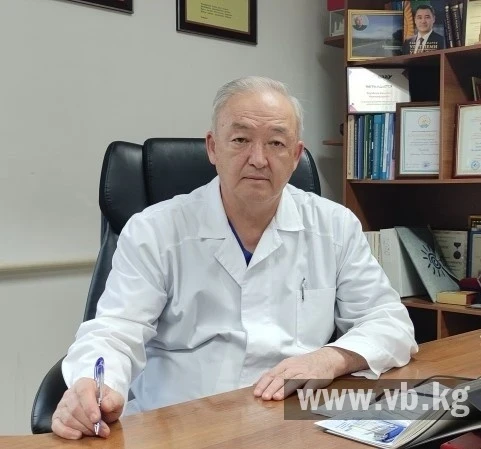
A key element in this process is scientific clinical bases. Professor and former Minister of Health Talantbek Batyraliev spoke in an interview about the significance of such bases for the formation of qualified doctors.
- Talantbek Batyraliev is an academician of the Russian Academy of Natural Sciences, Doctor of Medical Sciences, Professor, and a full member of the American College of Cardiology (MD, PhD, DSc, FACC, FSCAI, FAHA, FESC).
– What is the role of the clinical base for resident doctors?
– I’ll start with a joke: “Doctor, is it true that a resident will be operating on me?”
– Yes, that’s correct.
– What if he makes a mistake?”
– In that case, we will give him a two and won’t issue a certificate…”.
But seriously, it is important to understand that not all medical institutions operate at the required level. Leading clinics around the world practice inviting highly qualified specialists from different countries to work on a contract basis. This allows them to maintain their status as leading medical centers.
Such institutions can be considered exemplary clinical bases for young doctors undergoing internships or residency. However, there are not many such centers in the world.
In Central Asia, the only such center is a clinic in Astana, where the internationally renowned cardiac surgeon Yuri Vladimirovich Pya works. It meets strict international standards and is considered one of the best medical institutions offering a wide range of services in cardiovascular surgery. Yu.V. Pya established this center based on the best medical practices, having been invited to the country by its leadership.
Other medical universities, as a rule, are private and attract experienced educators for training, but these are not always world experts. This makes education more accessible and suitable for doctors who need to acquire specialties and practical skills.
A medical university that collaborates with several hospitals in one area conducts practical classes in these institutions. Ideally, resident doctors work in departments under the guidance of experienced mentors, which contributes to gaining practical experience. The closer the interaction between educators and doctors, the more knowledge residents acquire.
It should be noted that the concept of clinical bases is not new. It began to take shape in the mid-20th century when the symbiosis of science, education, and practical medicine showed the best results in training specialists.
– What is the current situation?
– In most countries, medical universities are becoming redundant for practical healthcare. In some regions, health leaders consider them a burden, seeking to limit their functions. However, when medical departments leave hospitals, this often leads to a deterioration in the state of medicine and even the closure of institutions.
– How can we balance the interests of quality training for doctors and the rights of patients?
– It is essential to strictly adhere to laws and protect patients' rights. First injections or surgeries must not be performed on real patients without prior practice on simulators.
However, no simulator can replace real clinical practice. In this context, the role of mentors becomes crucial. If a young doctor works without supervision, the risk of mistakes increases. At the same time, the presence of an experienced mentor reduces these risks, making the training process safer for patients.
The uniqueness of our legislative framework is that we can protect patients' rights while simultaneously providing young doctors the opportunity to learn in quality clinical bases, gaining practical experience without harming patients' health. It is only important to properly organize the ethical aspects and interaction between universities and medical institutions.