The Western Ghats' king cobra, known as Ophiophagus kaalinga, is an endemic species that is found only in the humid mountain forests of India. These snakes require specific climatic conditions, including cool temperatures, high humidity, and dense vegetation for their survival. It was previously believed that their range was strictly limited to mountainous areas, as lowlands are extremely unfavorable for them. However, in the past 20 years, there have been reports of these giant snakes being found in port cities and train stations significantly far from their natural habitat.
A team of researchers from India and the UK set out to understand how this vulnerable species ends up in ecologically unfavorable conditions. Typically, transportation infrastructure serves as a barrier separating animal populations, but in this case, it acted as a conduit connecting isolated wildlife areas and human settlements. The results of their work were published in the journal Biotropica.
During the study, data on animal rescues collected from 2002 to 2024 was analyzed, with 47 verified cases of king cobra sightings that had precise geographical data. Using the MaxEnt algorithm, the scientists created a habitat suitability map based on climatic indicators and satellite images of vegetation.
The resulting model clearly indicated that king cobras should be located in the interior forests of the state. However, among the 47 cases, over 10% were found in "red zones," where the species' chances of survival are extremely low. Statistical tests confirmed that conditions in these locations significantly differ from normal. Notably, all anomalous locations were in close proximity to railway tracks, within a radius of 200-330 meters.
The researchers reconstructed the movement mechanism. In mountainous areas like Castle Rock, the railway passes through dense forests, and snakes can crawl into stationary freight trains to seek shelter or hunt for rodents. As a result, when the train starts moving, the snakes become trapped and are transported 80-120 kilometers away, ending up on the coast or in industrial zones.
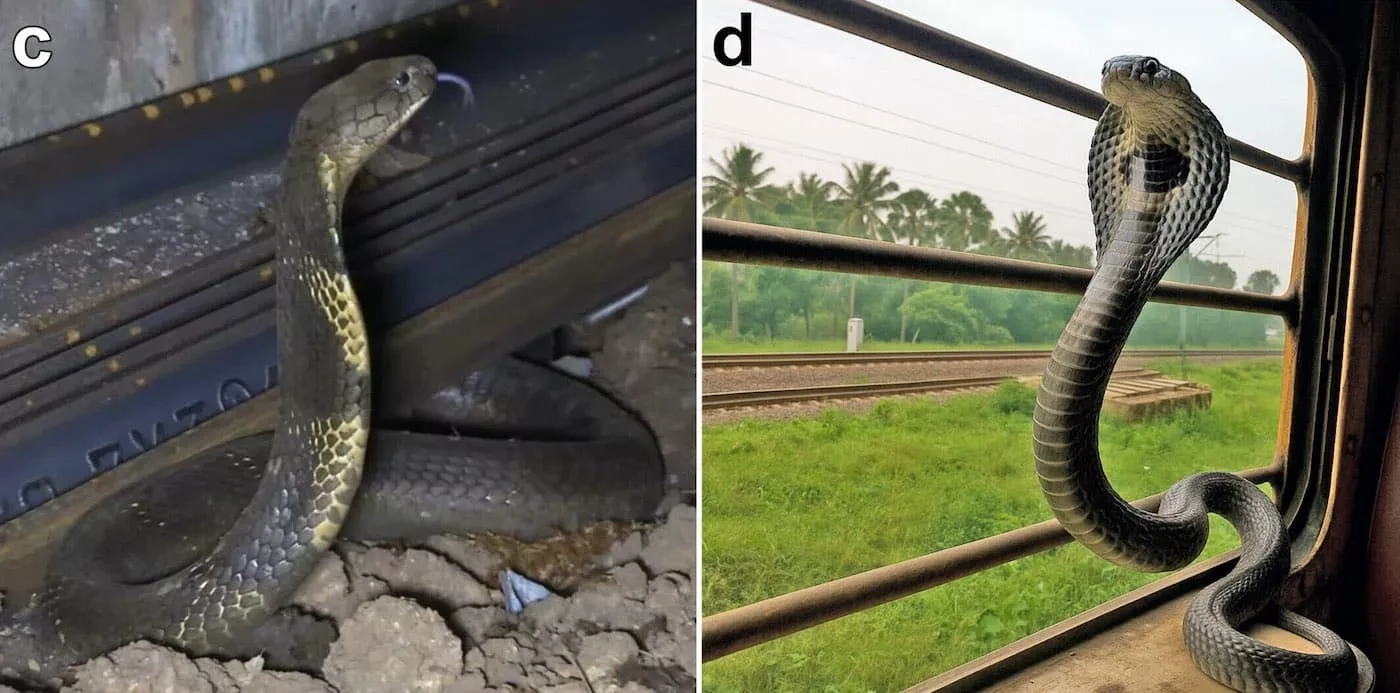
Observations confirmed this hypothesis: one of the "passengers" was found under the tracks at Chandor station, and in another case, witnesses captured footage of a cobra of another species, Naja naja, passing by in the window of a passenger car.
This work effectively documented a new type of interaction between humans and wildlife — "passive anthropogenic dispersion" of large predators. Although the sample size of five cases may seem small, for a secretive and rare species, this represents a significant portion of the population that regularly falls into "death traps." The scientists note that while their evidence is correlational (radio collars were not placed on the snakes), there are no alternative explanations for the appearance of forest endemics in arid areas.
The discovery raises serious concerns. Firstly, snakes that find themselves in new conditions are likely to face death due to a lack of moisture and familiar food sources. Secondly, this increases the risk to humans: a bite from O. kaalinga is fatal, and local hospitals often lack the necessary antivenoms for this species.
The authors of the study proposed an original solution: instead of simple monitoring, genetic analysis of snakes caught in cities should be conducted to accurately identify their "native" populations and return them to the forests, preventing genetic contamination and the death of rare individuals.