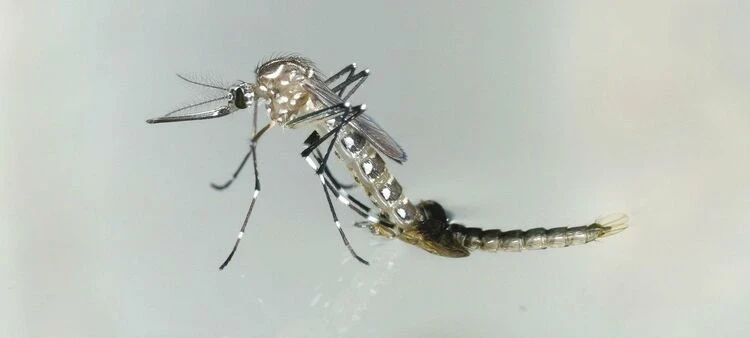
This shift significantly increases the risk of spreading dangerous viruses such as dengue and Zika.
As the area of the Atlantic Forest decreases, mosquitoes are increasingly turning to humans as their primary food source. This change could accelerate the transmission of insect-borne diseases and make communities near the forest more susceptible to disease outbreaks.
The Atlantic Forest, stretching along the coast of Brazil, is renowned for its vast biodiversity, including numerous species of birds, mammals, amphibians, and reptiles. However, much of this diversity has already been lost, and human activity has reduced the forest to one-third of its original size.
With the encroachment of humans into previously untouched ecosystems, wildlife is being displaced, and mosquitoes that once fed on a variety of animals are now switching to humans, as indicated by the study published in the journal Frontiers in Ecology and Evolution.
“We demonstrated that mosquitoes caught in the remnants of the Atlantic Forest clearly prefer human blood,” noted Dr. Jeronimo Alencar, the lead author of the study and a biologist at the Oswaldo Cruz Institute in Rio de Janeiro.
“This has serious implications, as in ecosystems like the Atlantic Forest, with a large number of potential hosts, a preference for humans significantly increases the risk of pathogen transmission,” added co-author Dr. Sergio Machado, a microbiology and immunology researcher at the Federal University of Rio de Janeiro.
To determine what mosquitoes are feeding on, the research team set up light traps in the reserves of Sitio Recanto and the Guapiacu River in the state of Rio de Janeiro. The researchers separated female mosquitoes that had recently fed on blood for further analysis in the laboratory.
The scientists extracted DNA from the blood samples and sequenced a specific gene that serves as a biological barcode. Each vertebrate species has a unique version of this genetic marker. By matching the barcodes with reference databases, the team was able to identify which animals had fallen victim to the mosquitoes.
The traps collected 1,714 mosquitoes of 52 different species. Blood was found in 145 females, and the researchers were able to identify the blood sources in 24 individuals, which included 18 humans, one amphibian, six birds, one member of the canid family, and one mouse.
Some mosquitoes fed on the blood of more than one host. For example, one mosquito identified as Cq. venezuelensis took blood from both a human and an amphibian. Mosquitoes of the species Cq. fasciolata also exhibited diverse feeding habits, including combinations of rodent and bird blood, as well as bird and human blood.
The researchers believe that such changes in mosquito behavior may be driven by multiple factors. “Mosquito behavior is quite complex,” noted Alencar. “While some species may have innate preferences, the availability and proximity of hosts play a crucial role.”
With ongoing deforestation and the expansion of human settlements, many species of plants and animals are disappearing. Mosquitoes are adapting to these changes by altering their habitats and foraging methods, often moving closer to humans.
Mosquito bites pose a serious health threat. In the studied regions, mosquitoes transmit viruses such as yellow fever, dengue, Zika, Mayaro, Sabia, and chikungunya, which can lead to long-term consequences. Scientists emphasize that understanding mosquito feeding preferences is crucial for studying disease transmission in ecosystems and among populations.
Additionally, the study revealed data gaps: less than seven percent of the captured mosquitoes had traces of blood, and sources could only be identified in 38 percent of cases. This highlights the need for more in-depth and large-scale studies, including advanced methods for detecting mixed blood sources.
Nevertheless, the findings have practical significance. They could contribute to the development of effective measures for controlling mosquito populations and improving early warning systems for disease outbreaks.
“By knowing the preferences of mosquitoes in certain areas, we can proactively warn about the risk of infection transmission,” concluded Machado.
“This will allow for targeted monitoring and preventive measures,” added Alencar. “In the long term, this could lead to the creation of control strategies that take into account the balance of the ecosystem.”