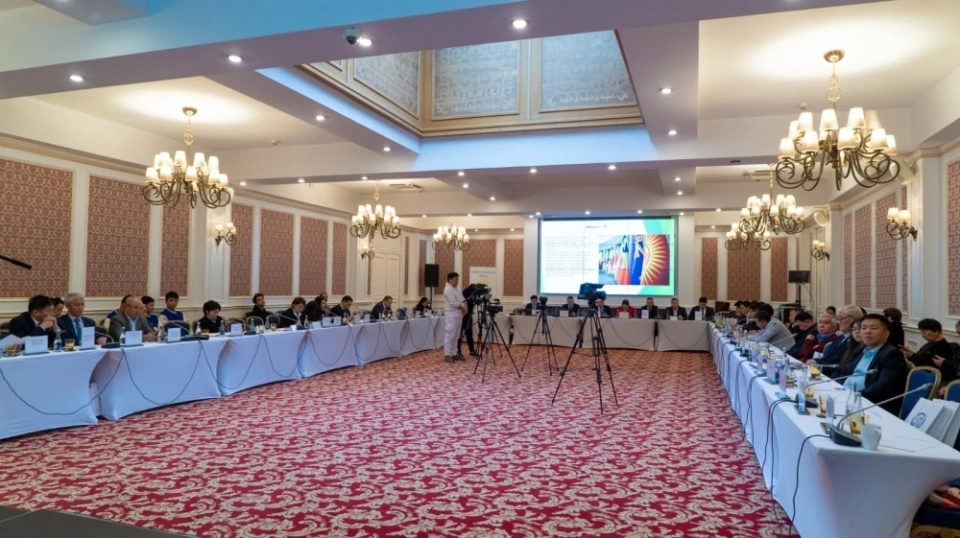
At the first meeting, one of the key issues was the changes regarding the introduction of the vice president position. Yerzhan Zhienbaev, the presidential assistant for legal issues, stated that the vice president will be appointed by the president with the consent of the Kurultai, obtained by a majority vote of the deputies. The dismissal from the position will also be carried out by the president.
Zhienbaev noted that the vice president will represent the country's interests in international relations and interact with the Kurultai, the government, and other state bodies. The powers of the vice president will be defined by the president, and it is also proposed to exclude the institution of the state advisor from the Constitution.
Halyk Kenesi — People's Council
The People's Council also came into focus, with its status planned to be enshrined in the Constitution. Yerzhan Zhienbaev emphasized that the Halyk Kenesi will represent the interests of the people and will be formed by the head of state from among the citizens of Kazakhstan. The council will have the authority to develop proposals for domestic policy, strengthen public consensus, and promote national values.
The president noted that the People's Council should have the right of legislative initiative, which requires enshrinement in the Constitution. It is expected that sessions of this council will be held at least once a year.
Structure of Parliament
State advisor Erlan Karin announced the main parameters of the new unicameral parliament. He reported that the Kurultai will consist of 145 deputies, and the requirements for candidates will remain the same. A proportional electoral system will be fully applied, and the term of office for deputies will be five years. There will be no presidential quota, but party quotas for women, youth, and people with disabilities will be maintained.
The Kurultai will consider bills in three readings, and the final decision on constitutional reform will be made by citizens in a nationwide referendum.
Sovereignty and Human Rights
Unzila Shapak, a deputy of the Mazhilis, proposed to amend the preamble of the Constitution, emphasizing national unity and sovereignty. Her ideas include mentioning the inviolability of borders and territorial integrity of Kazakhstan, which she believes is important for strengthening the country's sovereignty in modern geopolitical conditions.
Artur Lastaev, the human rights commissioner, suggested including in the Basic Law the right not to testify against oneself and one's relatives, as well as enshrining the principle of presumption of innocence. He emphasized the importance of protecting the right to life as a fundamental right.
Restrictions on Electability
At the second meeting, the discussion became more intense. Senator Nurlan Beknazarov proposed to introduce restrictions on participation in elections for citizens with unexpunged criminal records and those serving sentences. He also suggested granting the Kurultai the right to raise the issue of ministers' resignation.
Justice Minister Erlan Sarsembayev voiced the need to change the procedure for appointing key personnel. The president will appoint the vice president, prime minister, and members of the Constitutional Court with the consent of the Kurultai.
Additionally, Sarsembayev noted that the vice president will perform the duties of the president in case of his early dismissal and also proposed to adjust the functions of the government.
Funding and Citizens' Rights
Snezhanna Imasheva, a deputy of the Mazhilis, spoke about the planned amendments concerning political parties and trade unions. She emphasized the importance of clarifying the list of prohibited actions and sources of funding for parties and trade unions.
Discussions at the commission meetings continue, and each meeting leads to new proposals and changes. The fourth meeting is scheduled for Wednesday, January 28, where the amendments to the Constitution will be examined in detail. The final word on them will remain with the people in a referendum.