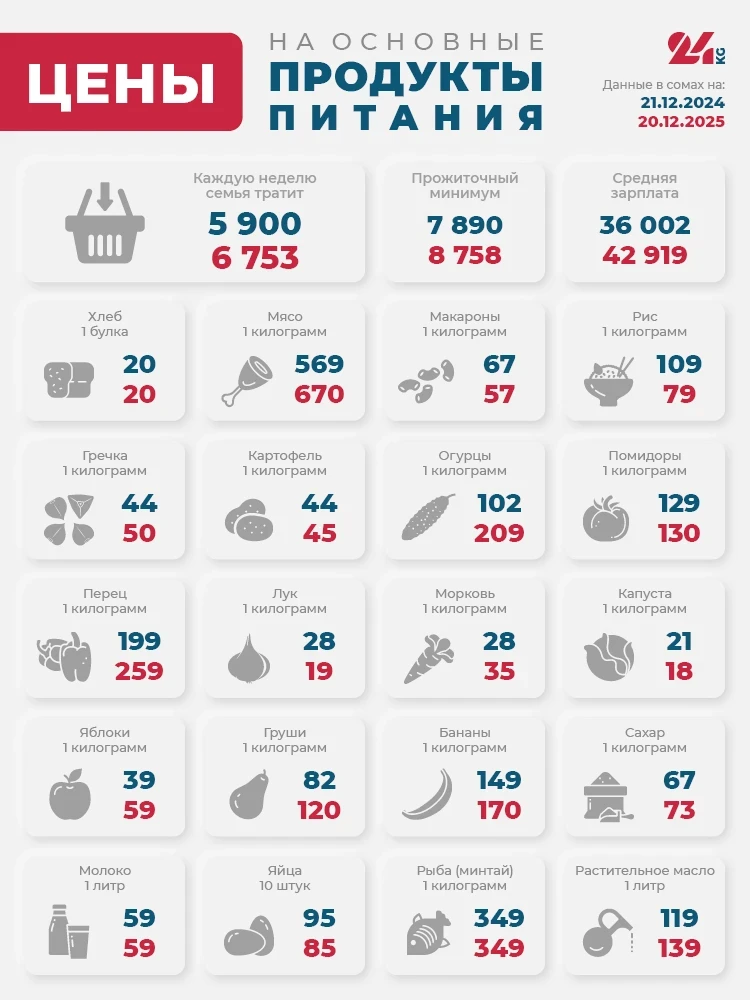
Kaktus.media has gathered opinions from specialists on how the pricing situation in the country will change.
How much will prices rise?
The Ministry of Finance of Kyrgyzstan estimates that inflation in 2026 will be 6.5%, which is higher than the 5.5% recorded for 2025. Price growth is expected to remain within single digits, provided there are no significant economic shocks.The National Bank, in a recent report on monetary policy, did not provide specific figures for inflation but indicated that current inflationary factors would continue to exert influence in 2026.
The NB KR noted: "Inflation is expected to be pressured by rising prices in neighboring countries, increased domestic demand, stimulating fiscal policy, as well as rising global prices for food and petroleum products."
According to forecasts, inflation may return to the target corridor by 2028; however, increases in utility tariffs and excise taxes may slow this decline. Inflation is projected to be 7.4% in 2027 and 6.2% in 2028.
Causes of inflationary growth
The World Bank expects inflation to exceed 9% in 2025 and reach 11% in 2026. This is one of the highest forecasts for price growth for the upcoming year, and economists highlight several contributing factors."The main factors for growth will be increases in wages and tariffs for electricity and heating. However, our baseline scenario assumes no significant global shocks in food and energy prices," notes Bakyt Dubashov, a senior economist at the World Bank.
Which goods will rise in price first?
Russia remains Kyrgyzstan's main trading partner, and changes in the economy of the neighboring country directly affect prices in Kyrgyzstan. It is expected that goods from Russia will become more expensive, particularly due to an increase in the VAT rate in Russia from 20% to 22% starting January 1, 2026, as well as a reduction in the threshold for small businesses regarding this tax.Among food products, the prices of the following are expected to rise the most:
- Coffee and confectionery (18-22%).
- Meat and dairy products — 12-15%, despite the preferential VAT of 10%, which will not fully compensate for the rising costs of fuel and feed.
- Some beverages, where price increases will be influenced not only by VAT but also by rising packaging and logistics costs.
- Dairy products — will also become more expensive due to rising feed and energy resource prices.
On a positive note, a decrease in global prices for vegetable oil is forecasted for 2026. Major importers such as India, Turkey, Iran, and China are reducing purchases, having large stocks, against the backdrop of increased supply: Russia has harvested a high yield of sunflower and remains the world's largest exporter.
According to futures quotes, further price declines are expected: Strategy Partners practice director Ekaterina Mikhaleva forecasts a decrease of 5% by the summer of 2026, while managing director of "Rexoft Consulting" Dmitry Krasnov expects a decline of 5-10% in the coming six months.
Prices for electronics: continued growth
In the second half of 2025, there was a rise in prices for SSD drives and PC RAM, caused by manufacturers shifting to more profitable production for data centers.As a result, almost all segments of technology and gadgets were affected. This primarily includes:
- RAM for PCs and laptops;
- SSD drives;
- Laptops and smartphones, where RAM chips and drives are key components affecting the overall price of the device.
Fuel: what awaits us?
According to the latest report from the World Bank Group "Commodity Markets Outlook," a decline in global prices for raw materials is expected in 2026, which will mean a drop in prices for the fourth consecutive year.The chief economist of the Eurasian Development Bank, Evgeny Vinokurov, noted that "a decrease in oil prices is forecasted for 2026-2027 compared to the average values of the last three years. The main reasons will be increased supply and the development of alternative energy. The average annual price for Brent is expected to be around $66 per barrel."
However, as 2025 showed, not everything depends on global prices. Supply issues can also lead to price increases. Managing partner of the trader "Proleum," Maxim Dyachenko, stated in an interview with "Kommersant" that unscheduled shutdowns of oil refineries in Russia became a key factor in the price increase for fuel this summer. According to his estimates, due to repairs and incidents at refineries, gasoline production decreased by almost 10%. In Kyrgyzstan, over the year, the price of AI-92 gasoline rose by 17.5%, AI-95 by 12%, and diesel fuel by 11.5%.
Experts believe that in 2026, gasoline prices in Russia may continue to rise, especially for AI-95, which is the most in demand. The dynamics will vary as the impact of sanctions and internal economic challenges create complex conditions with high costs and limited supply.