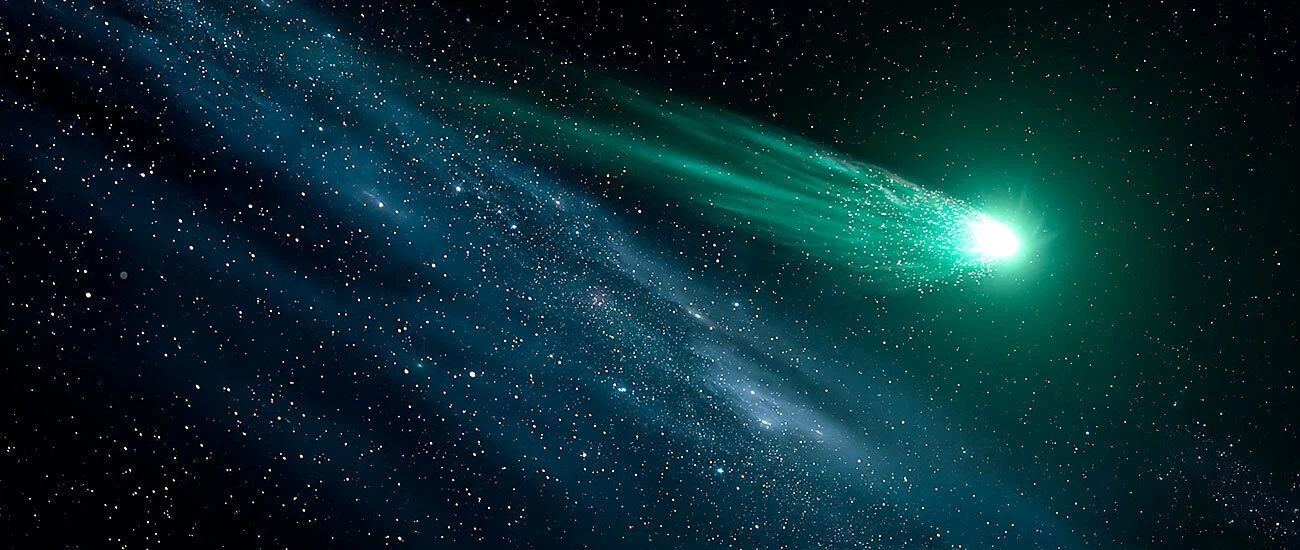
In the last ten years, astronomers have managed to record only three objects that have come from other star systems into our Solar System. The most notable among them is comet 3I/ATLAS, which is distinguished by its impressive size—over a kilometer in diameter—and a high speed exceeding 60 kilometers per second.
Avi Loeb, an astrophysicist from Harvard, has proposed an interesting hypothesis that such comets could serve as natural transport for interstellar travel. The scientist suggests that an advanced extraterrestrial civilization could hide a small spacecraft inside a comet, using the object itself as camouflage and a source of necessary resources.
One of the arguments supporting this theory comes from observations made by the solar observatory SOHO. The device recorded a powerful hydrogen outburst from the surface of 3I/ATLAS, and estimates suggest that the comet could have lost about 13.5 million tons of water in a month. Loeb believes that this water could be used for electrolysis, which would allow for the production of hydrogen and oxygen for rocket fuel.
This fuel reserve would enable the spacecraft to change its trajectory and move towards other planetary systems. Loeb does not rule out that some of the detected hydrogen may be related to this hypothetical activity.
The scientist also notes unusual characteristics of the comet's trajectory and behavior: its movement almost coincides with the plane of the orbits of the planets in the Solar System, its axis of rotation points towards the Sun even at significant distances, and the jets of material exhibit symmetry. Additionally, an abnormally high ratio of nickel to iron has been found in the composition of the comet. Although these features can be explained by natural processes, together they open up the possibility of an alternative interpretation.
According to Loeb, the presence of a technological device inside the comet provides a significant advantage, as it would be almost impossible to distinguish it from a regular celestial body during remote observations.
The scientist emphasizes that close examination of 3I/ATLAS could reveal the presence of an energy source necessary for the operation of the hypothetical device and the production of fuel. This discovery could fundamentally change our understanding of interstellar flights.
In the future, humanity could also use a similar approach. This would first require detecting a suitable interstellar object and then sending an autonomous device equipped with a power source and an artificial intelligence system to it. Such a device could function without communication with Earth and use the natural object for movement between stars.