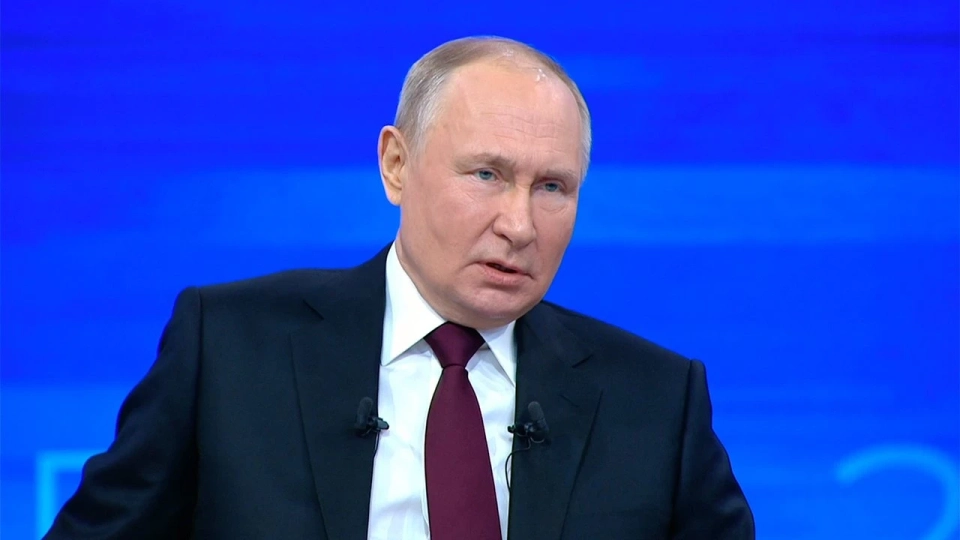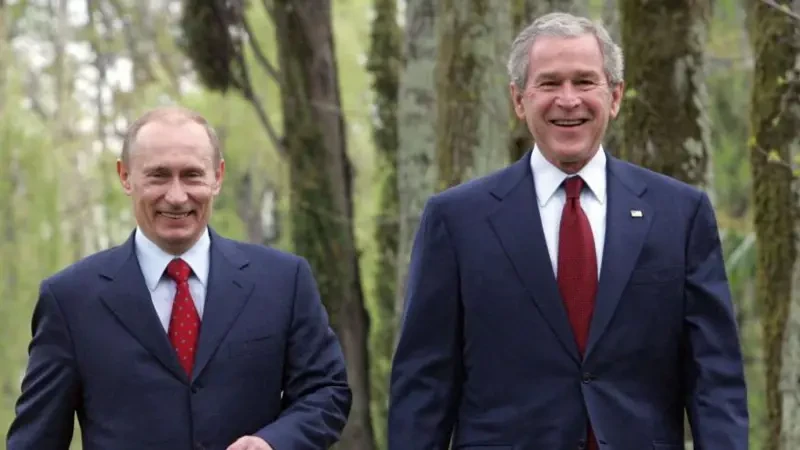
The published transcripts pertain to three meetings between Putin and Bush that took place in 2001, 2005, and 2008, resulting from a lawsuit filed by the “National Security Archive” under the Freedom of Information Act.
In the first meeting, held on June 16, 2001, at the “Brdo” castle in Slovenia, Putin raised the issue of lost territories, which also confirms his concern about this matter at the beginning of his presidency, according to a transcript made by the BBC.
At that time, Bush had just begun his term as the 43rd president of the United States, having taken the oath of office in January 2001, and Putin had just come to power after winning the elections in March 2000.
First Meeting: Friendly Atmosphere and Discontent Over Losses
According to the transcript, the leaders displayed friendliness and a desire to strengthen relations between Russia and the West.
Bush invited Putin to his ranch in Texas and noted that “a strong Russia is in our interest.” In response, Putin emphasized the importance of honesty in relationships and noted his popularity in Russia, explaining it by saying that he “listens to the people.”
Putin also mentioned that Russians feel deceived and that the changes that led to greater freedom were not fully utilized. He then briefly touched upon issues of historical justice and territorial losses.
Even back then, Putin showed interest in historical and territorial issues, which later became a theme in his negotiations with Western leaders, especially in the context of the conflict in Ukraine. He told Bush: “Russians gave away thousands of square kilometers of territory voluntarily. It’s unheard of! Ukraine, which has been part of Russia for centuries, was given away. Kazakhstan was given away. The Caucasus too. It’s hard to imagine.”
Putin also expressed dissatisfaction with how Western countries treated Russia, particularly regarding unresolved debt issues and the ignoring of radical groups' actions in Chechnya.
At this meeting, Putin also raised the issue of NATO expansion and expressed dissatisfaction that Russia “feels left out” in this matter. He reminded that in 1954, Russia attempted to join NATO, but its application was rejected.
Bush asked questions about press freedom in Russia, mentioning the transition of the “NTV” channel under the control of “Gazprom-Media.” In response, Putin accused the former owner of “NTV,” Vladimir Gusinsky, of corruption.
Meeting in 2008: “Ukraine as an Artificial State”
The last personal meeting between Putin and Bush took place on April 6, 2008, at Putin's residence “Bocharov Ruchey” in Sochi, and its tone was noticeably different from previous ones, where issues of cooperation and mutual understanding were discussed.
These negotiations occurred shortly after the NATO summit in Bucharest, where the US sought to include Ukraine and Georgia in the alliance.
NATO members decided not to provide Ukraine and Georgia with a Membership Action Plan but noted that both countries could become members in the future. Putin perceived this as a threat to Russia's security, and a few months later, Russian troops invaded Georgia.
At the meeting, Putin and Bush discussed issues of missile defense in Europe, after which Putin expressed concern about NATO expansion, claiming that “Ukraine's accession to NATO would create a long-term conflict.” Bush, curious about his opinion, asked “why,” to which Putin replied that Ukraine is “an artificial state created in Soviet times.” These arguments were later used to justify the invasion of Ukraine.
Putin also stated that many Ukrainians perceive NATO as a hostile organization and that Ukraine's accession to NATO would pose a threat of military bases being placed near Russia.
Putin Warned Bush About the Possibility of Destabilizing Ukraine
The transcript shows that Putin warned Bush about Russia's readiness to “create problems” in Ukraine to prevent its accession to NATO.
He claimed: “Russia can work to ensure that NATO no longer has the opportunity to expand” and that “there could be problems in Ukraine.” Putin also questioned the feasibility of Ukraine's NATO membership, asking what benefits it would bring to the alliance and the US.
According to polls, Putin was mistaken in claiming that 70% of Ukrainians opposed joining NATO. In fact, a survey conducted in the spring of 2008 showed that 59% of respondents were against it, 22% were in favor, and 19% were undecided.
Interestingly, after the start of the full-scale invasion, the proportion of supporters of Ukraine's NATO membership significantly increased. According to a survey in the fall of 2024, over 82% of Ukrainians support the idea of joining the alliance.
During the meeting with Bush, Putin also stated that they were against Ukraine's accession to NATO but suggested waiting until the majority of the population supports this idea.
Russia considers Ukraine's refusal to join NATO a necessary condition for ending the war. Ukraine realizes that the current US leadership and some other Western countries are not ready to accept it into the alliance but demands similar security guarantees as in Article Five of the NATO Charter.
Joining NATO and the European Union is also enshrined in the Ukrainian constitution.
In response to Putin's objections regarding Ukraine and Georgia's accession to NATO, Bush noted: “I appreciate that you openly expressed your position on NATO. That was commendable, and you were listened to carefully.”
Additionally, the “National Security Archive” published a transcript of another conversation between Putin and Bush that took place on September 16, 2005, in the Oval Office. This conversation addressed issues of nuclear non-proliferation and Russia's relations with Iran and North Korea.
“The conversation demonstrated the closeness of positions on Iran and North Korea, with Putin showing himself as an interested partner,” the authors of the publication noted.