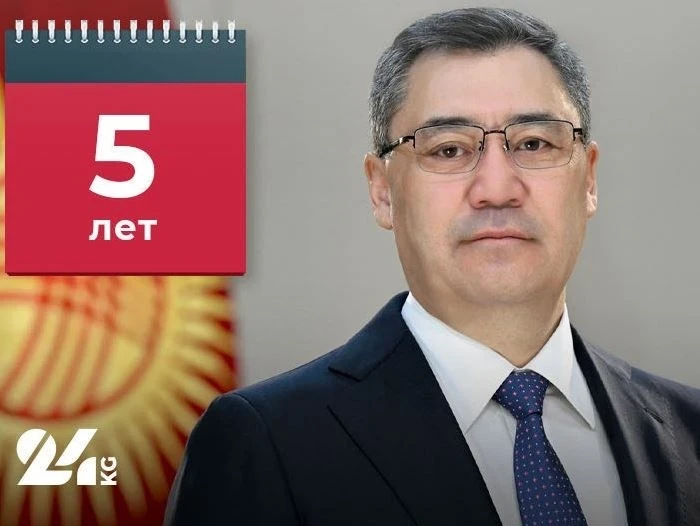
The personnel appointments made by President Sadyr Japarov in the security sector, as well as the announced reforms, highlight not only the conferral of ranks but also a new political advance that indicates responsibility in the context of global changes in the state security system.
The awarding of the rank of lieutenant general to the head of the State National Security Committee (GKNB), Jumgalbek Shabdanbekov, and the general ranks to his deputies strengthens the vertical management structure within this special service. In security agencies, such steps are seen as an expression of trust and a signal of personal responsibility for the upcoming transformations. This confirms the head of state's intentions to ensure the manageability of reforms and clear accountability of leadership for their results.
These personnel changes occur against the backdrop of broader initiatives. Sadyr Japarov announced the establishment of a new Investigative Committee, which will be directly subordinate to the president. This decision was a response to systemic issues of pressure on investigations. Under current conditions, operational units and investigators work within the same agency, which creates risks for the objectivity of investigations.
If the new structure can indeed serve as a barrier against inappropriate or fabricated materials, Kyrgyzstan may move closer to strengthening the procedural independence of investigations—a question that has been discussed for many years. At the same time, the committee's subordination to the president enhances the management vertical and accountability for final results.
The head of the GKNB also articulated the main idea of the agency's reform: the depoliticization of the service, the rejection of party influences, and an emphasis on professionalism in appointments, which will help eradicate regional preferences. The creation of a personnel system based on competencies reflects a desire for a more mature model of public administration.
Changes in working methods are also of significant importance. The GKNB plans to shift from rigid forceful approaches to legal and civil mechanisms for ensuring security. If this course is implemented consistently, it will lead to a reduction in demonstrative operations and strengthen legality in the process.
Structural changes have already begun to be implemented: units of state protection and the Border Service have been removed from the GKNB, indicating a desire to relieve the agency and enhance its specialization. At the same time, staff optimization is underway, analytical work is being strengthened, and personal responsibility among employees is being increased.
Attention is also focused on changing anti-corruption policies. Authorities acknowledge that the previous model was based on demonstrative arrests and harsh measures from leadership. The new strategy involves a transition to a systemic, procedural approach to combating corruption, which is less noticeable in public but more sustainable in the long term.
The statement on the inadmissibility of unjustified pressure on business has become an important signal. Reducing forceful interference in entrepreneurial activities can significantly increase trust in the state and contribute to economic stability.
Moreover, the understanding of threats is also changing. Cybercrime, information-psychological operations, transnational crime, and the protection of information space are now at the forefront. Security is increasingly defined not only by force capabilities but also by the resilience of the digital environment.
The rejection of demonstrative "mask shows" and the transition to a more closed, professional approach reflects a desire to reduce the politicization of force operations and bring them closer to modern standards of intelligence work.
As a result, the conferred general ranks, institutional reforms, and structural changes form a unified strategy. The initiated transformations indicate a desire to adapt the security system to modern management and legal standards.
The success of the further implementation of reforms will be a key factor in their effectiveness and will determine how adequately the new security architecture can respond to contemporary challenges.