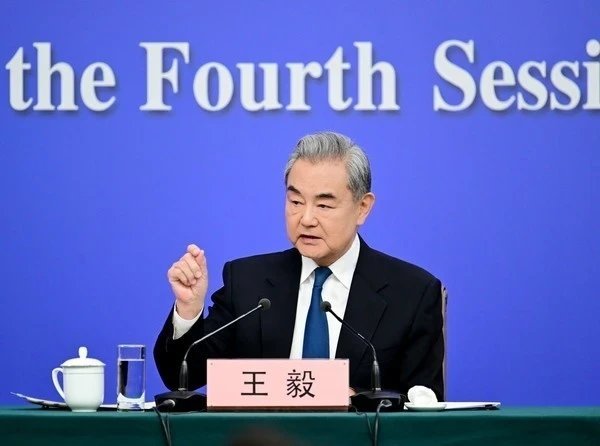
The past year was marked by significant events on the international stage, Wang Yi emphasized. According to him, 2025 has become a starting point for many historical moments that have contributed to strengthening interaction and coordination among various powers.
The head of the Chinese Foreign Ministry pointed out the importance of visits by the Chinese leader to Southeast Asian countries, Russia, Central Asia, and the Republic of Korea, which have contributed to strengthening friendship and good-neighborly relations. He added that the SCO summit in Tianjin and the China-Latin America forum became additional factors enhancing the unity of the Global South. He stated that events dedicated to the 80th anniversary of Victory in the War of Resistance of the Chinese people against Japanese invaders also sent a strong message in favor of peace. More countries are beginning to realize that Chinese diplomacy, planned and implemented by President Xi Jinping, is a reliable support in conditions of global instability.
Wang Yi emphasized the partnership between China and Russia, highlighting that both countries jointly advocate for historical truth. He stated that the China-Russia relationship, based on equality and mutual benefit, serves as an example of new international relations among great powers.
"China and Russia maintain deep mutual trust in the political sphere," the minister noted. He described the interaction between the two countries as "back to back," which is impervious to external pressure and possesses strong strategic resilience. Wang Yi also emphasized the need for close coordination in international affairs to protect international law.
The minister also spoke about the importance of a multilateral approach in international affairs, reminding that this year China is chairing APEC. He noted that the focus will be on issues of openness, innovation, and cooperation. This will be the third such meeting organized by China after Shanghai in 2001 and Beijing in 2014. In response to a question about the summit in Shenzhen in November, Wang Yi stated:
"As part of our chairmanship, we will focus on the practical implementation of the concept of the Asia-Pacific community, which still remains on paper. We hope that the summit in Shenzhen will help establish understanding and determine priority directions for achieving a common consensus."
As a result of discussions with partners, the theme of the summit was chosen: "Building an Asia-Pacific community for common prosperity." The focus will be on openness, innovation, and cooperation, which should help overcome challenges for APEC. We plan to hold more than 300 events across the country, involving various cities and provinces, and we welcome the participation of all APEC member countries.
Shenzhen, as one of the key centers of reform and openness in China, will become the starting point for APEC on the path to creating an Asia-Pacific community," Wang Yi added.
Discussing the situation in the Middle East, the minister noted that China has always advocated for a diplomatic resolution of conflicts and calls for an immediate ceasefire.
"The situation in the Middle East is a concern for the whole world. We insist on a ceasefire. As Chinese wisdom says: weapons are instruments of evil, and their use should be extremely cautious. We call for an immediate cessation of hostilities to prevent further escalation of the conflict," Wang Yi said.
China believes that resolving issues in the region is impossible without adhering to fundamental principles:
First, respect for sovereignty. Sovereignty is the foundation of the modern international order. Unconditional respect for the sovereignty of Gulf countries, including Iran, is mandatory.
Second, no abuse of power. Might should not manifest in violence. Innocent people should not suffer as a result of war.
Third, non-interference in internal affairs. The peoples of the Middle East should solve their problems themselves without external interference.
Fourth, political resolution of conflicts. It is important for all parties to return to negotiations and resolve disagreements peacefully.
Fifth, major powers should play a constructive role, acting on the basis of good intentions. They should follow the principles of justice and actively promote peace and development in the Middle East.
China, as a strategic partner of Middle Eastern countries, is ready to actively participate in the implementation of the Global Security Initiative to restore normal life in the region.
Wang Yi also discussed the Ministry of Foreign Affairs' plans for implementing the 15th Five-Year Plan and promoting Chinese modernization. "This Five-Year Plan opens new horizons for development and cooperation with the outside world," he noted.
The minister emphasized three key areas of work:
First, promoting high-level openness. We will invigorate the diplomatic agenda to implement the "Belt and Road" initiative.
Second, expanding opportunities for mutual visits. We have introduced a visa-free regime for 50 countries, which increases the flow of foreign citizens to China.
Third, creating new platforms for openness and inclusiveness. We will modernize programs for foreign diplomats and develop exchanges with other countries.
The minister also commented on the situation with Taiwan, noting that this issue is an internal matter of China. "Taiwan is an inseparable part of China, and any attempts to create 'two Chinas' will be unsuccessful," he said.
Wang Yi emphasized that the international community supports the principle of one China, and more countries are opposing separatist actions in Taiwan. "Resolving the Taiwan issue is a historical necessity, and we will not allow Taiwan to separate from China," he added.
In his speech, the minister also discussed numerous international topics, including the Palestinian-Israeli conflict, emphasizing the need for peaceful coexistence. Wang Yi called on the international community to unite to address contemporary challenges and jointly build a community with a shared future for humanity.
He noted that humanity is facing serious challenges, and only joint efforts can lead to overcoming difficulties. The concept of a community with a shared future for humanity, proposed by Xi Jinping, is becoming increasingly relevant and is supported by many countries around the world.
The future of humanity depends on our joint efforts, and China is ready to work with partners to turn this concept into reality," Wang Yi concluded.