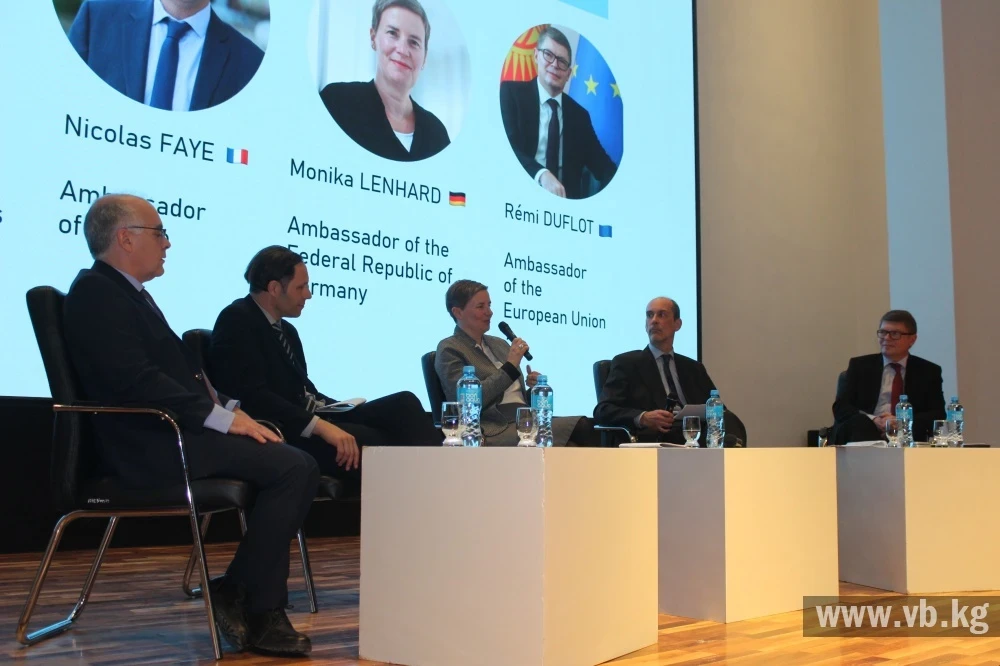
- How does the Aachen Treaty influence cooperation between France and Germany in Kyrgyzstan? What projects are planned jointly?
- It should be noted that the Aachen Treaty was signed on January 22, 2019, the day that marks the anniversary of the Élysée Treaty of 1963. This historic document, signed by President Charles de Gaulle and Chancellor Konrad Adenauer, became a key moment in the reconciliation of France and Germany after World War II. It put an end to the perception of the two countries as sworn enemies and opened the way to friendship and integration in Europe. Within the framework of the Aachen Treaty, France and Germany reaffirmed their commitment to close cooperation based on the principles of historical reconciliation.
This certainly influences our interaction in third countries, including Kyrgyzstan. The Aachen Treaty mentions Bishkek as one of the four cities in the world where an integrated Franco-German cultural institute will be established, significantly enhancing our cultural ties. The official opening of the institute is scheduled for the second half of this year, but the FGCI (Franco-German Cultural Institute) has already begun its activities in Kyrgyzstan. For over four years, we have been organizing joint cultural events focused on youth and creative industries such as cinema, video games, and animation. We aim to reach not only Bishkek but all regions of the country.
- How does this treaty affect the EU's foreign policy towards Kyrgyzstan and Central Asia?
- Close cooperation between France and Germany is an important element of the overall European project known as the European Union. The reconciliation between our countries has become the foundation for European integration, which is why they are often referred to as the "engine of Europe." We look beyond Europe and strive to bring fresh ideas into European foreign policy.
In 2007, Germany and France became the main initiators of the first EU strategy for Central Asia, which was updated in 2019. Among our priorities are strengthening resilience, regional cooperation, and development. These areas remain the foundation of the EU's foreign policy in this region. We actively work with the EU delegation and other EU members to support Kyrgyzstan in these areas.
The Agreement on Enhanced Partnership and Cooperation (EPCA), signed by the EU with Kyrgyzstan in June 2024, represents an important step towards deepening interaction. We hope for its prompt ratification by all EU members and Kyrgyzstan. We also look forward to the first EU-Central Asia summit, which will take place in April 2025 in Samarkand and will be an important milestone in the development of our strategic partnership.
We are confident that a strong partnership between France and Germany at the local, regional, and federal levels in the areas of security, economy, culture, science, and interpersonal contacts can inspire closer cooperation in the region. We are always ready to share our experience. In this context, we welcome the recent successes in the peaceful resolution of border issues in Central Asia, which is a significant step towards stability and prosperity in the region, making it more attractive on the global stage.
In both cases, political will and strategic foresight were important factors. In the context of global violence, it is especially important to maintain a spirit of constructive cooperation and uphold the principles of the UN Charter.
- How does this affect security and strategic partnership in Central Asia?
- Germany and France believe that EU-Central Asia cooperation should focus on creating a sustainable, prosperous, and interconnected economic and political space. The EU has long been a partner of Central Asia on security issues.
Among the areas where the EU and the countries of the region intend to strengthen cooperation are cybersecurity, countering hybrid threats, preventing radicalization and terrorism, enhancing border security, and combating drug trafficking and human trafficking.
EU cooperation with Central Asia is not exclusive. We continue to engage with international organizations such as the OSCE and the UN, which play an active role in the region.
- Can the Aachen Treaty become the foundation for a new security architecture in Europe, especially in light of the escalating situation around Greenland?
- As EU and NATO members, our countries traditionally pay attention to security and defense. The results of the Franco-German Security and Defense Council meeting held in Toulon in August 2025 show that, in striving to maintain an international order based on rules, Germany and France are confident in the need to further strengthen bilateral cooperation in foreign policy and security. This confirms the ambitions laid out in the Aachen Treaty.
We aim to contribute to the formation of a Europe that can take greater responsibility for its defense and more effectively address current and future challenges, including internal issues within the European Union.
This topic was also reflected in the Franco-German economic program adopted at the ministers' council meeting in Toulon. It outlines guidelines for building a more sovereign Europe with a focus on competitiveness and development in areas such as energy, artificial intelligence, and advanced technologies.
In the context of war, the rise of hybrid threats in Europe, and numerous global crises, we are confident that NATO remains the foundation of Euro-Atlantic security. Our countries are ready to strengthen the Alliance, including by enhancing the European wing. This should remain a focus on both sides of the Atlantic. Greenland, as an autonomous territory within the Kingdom of Denmark, is part of NATO, and its security affects the interests of all allies.