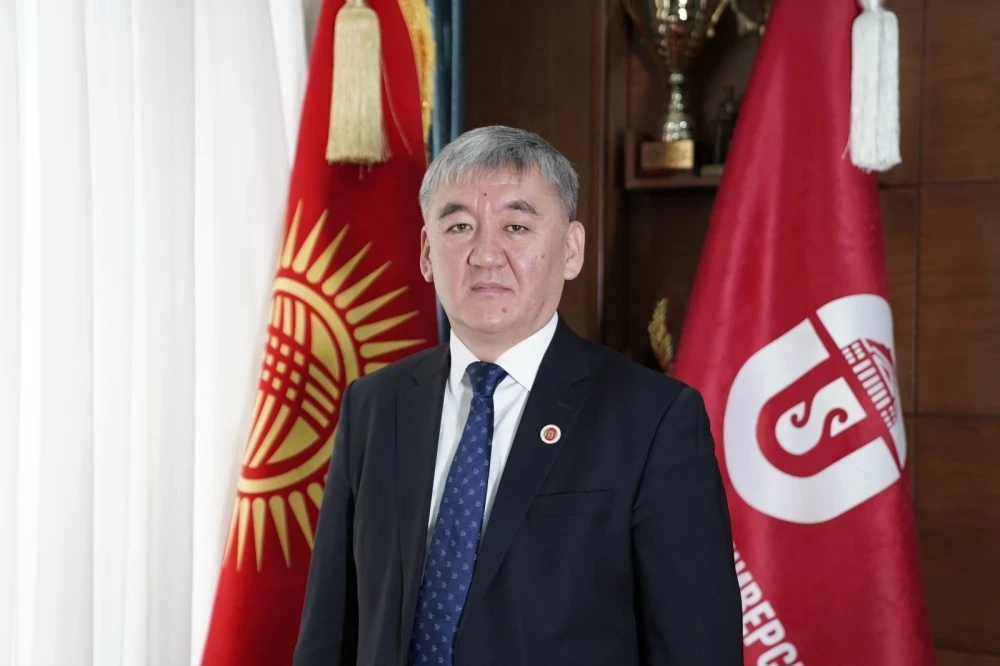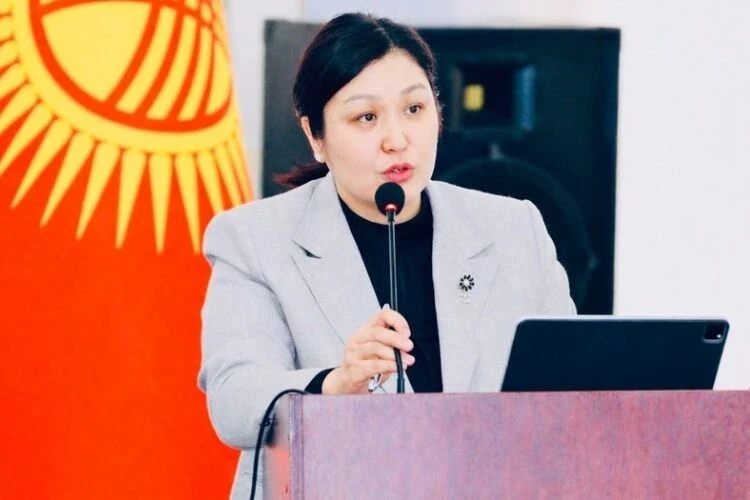
Gulzat Isamatova, who holds the position of Minister of Science, Higher Education and Innovations of the Kyrgyz Republic, shared her priorities for reforms in her first interview with 24.kg.
— Gulzat Tynibekovna, to be honest, for many you remain a little-known figure. Your name is not widely recognized, and even in the editorial office, some journalists needed time to remember your last name. Let's start with more general questions.
— I agree, I understand that my recognition among the general public is limited. This is normal, as I am not a public figure like show business stars and have not worked in politics. It took me time to sort out many personnel and structural issues, and now I am ready for an open dialogue.
— You hold a degree of Candidate of Political Sciences, a master's degree in international law, and a specialization in higher education pedagogy. This is quite a unique combination.
— Some say I studied for too long (laughs). But for me, education is not just diplomas; it is a tool for work. Political science helps to understand institutions, international law provides the rules of the game, and higher pedagogy explains how a person learns. A minister in my field without an understanding of pedagogy remains a theorist, and without knowledge of politics, an idealist. It is necessary to combine both aspects.
— There is a high demand in society for changes in the field of education and science. Where do you think reforms should begin?
— First of all, with honesty. We have viewed education for too long as a set of departmental processes: programs, reports, indicators. However, education is not just a sector of the economy; it is the foundation of future society, a kind of framework. If we do not define what kind of highly educated Kyrgyz citizen we want to see in 10-15 years, any reforms will remain superficial.
— It is often heard that the education system is lagging behind global changes. Do you agree with this point of view?
— I partially agree. The problem lies not only in speed but also in logic. The modern world has become uncertain, while the education system continues to prepare for predictable paths. It is important to teach not only knowledge but also the ability to adapt, think, and work with uncertainty. This is more complex than simply rewriting textbooks, but without it, we risk reproducing vulnerability rather than development.
— Is the launch of the accelerated modernization program for universities, mentioned by Deputy Prime Minister Edil Baisalov, related to this? What is its essence?
— The essence is to change the perception of the university. We must stop seeing it as a budget institution with a fixed schedule and start viewing it as a center for the production of knowledge, technologies, and human capital. A university is not just a building; it is a gathering point for the future of the country.
Our task is to transform universities into centers of attraction for talents, intellectual hubs that will shape the economy of 2035-2040. This is not just a slogan but a management assignment.
— Speaking about the results of university autonomy, many express doubts. Is there progress or an expectation of instructions? Does it not seem that the reform has stalled?
— Reform is always a nonlinear process. Autonomy is a path to maturity. Not all educational institutions are ready to bear this responsibility. The presidential decree on expanded autonomy is a historic step. For the first time, the state tells universities: we trust you to manage finances, build structures, open programs, and attract partners. Some universities have understood this, while others are waiting for instructions. I want to emphasize that the time for waiting is over.
— This sounds quite harsh. Are personnel changes expected?
— If autonomy is used as an excuse for inaction, then yes, personnel decisions are inevitable. We will not finance the imitation of reforms.
However, we must not allow the other extreme, where the rights of students or the principles of transparency are violated under the pretext of autonomy. University autonomy is not lawlessness but maturity. It is important for universities to be able to independently form budgets, flexibly manage salaries, open new programs, attract international partners, and create startups. The state remains the guarantor of standards.
— However, critics argue that university autonomy may lead to commercialization and a decline in quality.
— I will start by saying that commercialization is not a negative phenomenon. It is the ability to turn knowledge into economic results. But yes, there are risks such as underfunding, staff shortages, and a digital divide.
Therefore, we are also launching a KPI model for evaluating universities, revising licensing, and creating the "University - Startup Factory" program, as well as forming venture mechanisms.
In addition, universities will be able to attract loans, use leasing, open accounts in commercial banks, and manage income from innovative activities. These are already tools of a "mature" economy.
— You also plan to reform science and the National Academy of Sciences. Is this a separate initiative?
— No, this is part of a unified process. Today, science in Kyrgyzstan is fragmented: academic, university, and sectoral. There is low flexibility, weak commercialization, and dependence on budget funding.
The draft presidential decree on reforming scientific activities provides for broad financial autonomy for research institutes. This means they will be able to attract international grants, create startups, and form targeted capital funds, flexibly compensating scientists' labor. We are moving from a "passive budget" model to a sustainable development model.
The modern academy of sciences should fill systemic gaps in the economy, not just report on conducted research.
— Science is often perceived as a closed and detached sphere from society.
— Modern science must either become socially significant or marginalize itself. We must restore science's status as a source of solutions, not just publications. This requires new communication with society, business, and the state, without which the scientific potential cannot be realized.
— In the name of your ministry, there is the word "innovation." What do you mean by this concept: only technologies or something more?
— Innovation is not just startups and scientific laboratories. It is the ability of society to renew itself without destruction. Sometimes innovation is not a new technology but a new approach to organizing the educational process, scientific environment, or university. Therefore, for me, innovation is a bridge between knowledge and real life, not an end in itself.
— Are you ready for resistance from the system?
— Any reform touches the interests of certain groups, so resistance is inevitable, and it is already manifesting. However, I have a carte blanche from the president, which is important. I never wage war; I prefer dialogue. It can be tough and reasoned, but it is still dialogue. Our task is not to destroy the system but to modernize it.
— And finally, why should people remember your name?
— If in a few years, a new generation of scientists, entrepreneurs, and engineers emerges in Kyrgyzstan who will speak of this time as a period of changes in the system, even without mentioning specific names, that will be enough. I am confident that Kyrgyzstan deserves an intellectual breakthrough, and we will achieve it.