For Malaysia and other Southeast Asian countries, the changes occurring in India have specific significance. India is becoming an important player in their economic and geopolitical strategies, providing support in matters of stability, security, food and energy supply, access to technology, and strategic flexibility.
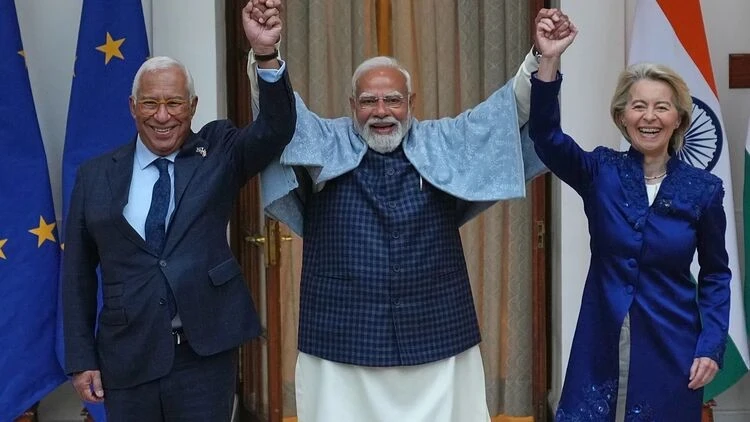
Therefore, Prime Minister Narendra Modi's visit to Malaysia on February 7-8 is of immense strategic importance. For Kuala Lumpur, it is an opportunity to shift from a traditional approach to a balanced policy, recognizing India as a key strategic partner for the coming decades.
India: Economic and Demographic Breakthrough
According to the International Monetary Fund, India continues to be the fastest-growing major economy in the world, with a projected real GDP growth rate of around 6.4%, while many developed and developing countries barely reach 3%.India's nominal GDP has already surpassed $4 trillion. According to forecasts from the IMF and the World Bank, within this decade, the country could surpass Japan and Germany, and by 2040 become the largest economy in the world.
These forecasts are based on real factors: a large domestic market continues to develop, the demographic structure remains favorable, and government investments are increasing. Industrial production is expanding, and the economic growth model is gradually shifting from consumption to investment and productivity enhancement.Over the past decade, especially under Modi's leadership, India has implemented numerous structural reforms that many large democracies struggle to achieve: the introduction of a Goods and Services Tax, the unification of bankruptcy procedures, the creation of digital financial platforms, and the implementation of large-scale infrastructure projects. These measures have strengthened government institutions, reduced transaction costs, and improved capital allocation.
India's demographic indicators continue to grow, while China is experiencing stabilization. Despite the ongoing influence of Beijing, the country faces challenges such as a high debt level, vulnerability in the real estate market, and demographic decline.
According to World Bank forecasts, China's economic growth rate will decrease from 4.9% in 2025 to 4.4% in 2026 and 4.2% in 2027, which is part of a broader long-term slowdown.
In this context, India's growth becomes not only an economic phenomenon but also a military-political one, creating a counterbalance without direct confrontation.
“Act East” and “Made in India” Strategies: Benefits for Southeast Asia
The “Act East” strategy, launched in 2014, has established India as a permanent player in the Indo-Pacific region with long-term interests in the security and prosperity of Southeast Asia. It has enhanced transport connectivity and integration, supporting regional balance and creating an economic-defense “umbrella.”This policy brings ASEAN back to the center of strategic discussions, from the Andaman Sea to the Malacca Strait, where India is expected to play a significant role and provide assurance amid rising tensions.
If “Act East” strengthens India's strategic depth, then the “Made in India” strategy enhances its economic significance.
Together, they create synergy: India becomes a market, a manufacturing base, and a provider of security.Industrial policy strengthens the economic foundation by reducing dependence on the service and consumption sectors. A more robust manufacturing ecosystem creates alternative production centers and strengthens regional supply chains.
The Digital India program has completed the technological transformation of the country, creating one of the most scalable digital economies in the world. It reduces transaction costs, expands access to finance, supports small businesses, and accelerates the adoption of technologies in AI, fintech, and e-governance.
This opens new opportunities for Malaysia and ASEAN countries in the fields of digital inclusion, fintech, cybersecurity, and digital trade.
Today, India has over 200,000 registered startups covering fintech, health technologies, defense solutions, artificial intelligence, and space projects, making it one of the largest innovation ecosystems in the world.
Special attention to strategic sectors such as semiconductors opens new opportunities for Malaysia as an important hub in the global chip manufacturing chain. This partnership complements the competencies of both sides: India offers scale and demand, while Malaysia provides integration and manufacturing depth.
In the energy sector, India is gradually becoming one of the largest markets for renewable energy, storage systems, green hydrogen, and grid enhancements, creating opportunities for joint investments, technology transfer, and supply chain diversification.
This cooperation allows Malaysia to move up the value chain, avoid the “middle-income trap,” and attract quality investments.
The issue of food security is also gaining significance: in 2024, India allowed a one-time shipment of 200,000 tons of non-Basmati rice to Malaysia, making an exception to export restrictions and thus confirming its readiness to be a stabilizing partner amid market instability.
Deepening Trade Relations
Over the past decade, the volume of bilateral trade has almost doubled, reaching approximately $19-20 billion per year. Malaysia has become one of India's key partners in ASEAN, while India is an important partner for Malaysia in South Asia.Malaysia exports electronics, semiconductors, palm oil, chemicals, and petroleum products, while India supplies refined fuels, pharmaceuticals, equipment, metals, food, and IT services.
India remains one of the largest buyers of Malaysian palm oil, thus ensuring a stable market, while supplies of Indian pharmaceuticals contribute to improved access to healthcare in the country.
If by 2030 India's economy approaches $7 trillion, and the middle class grows by hundreds of millions, the trade corridor between the countries could become one of the most dynamic in Asia.
People-to-People Connections and “Soft Power”
The relationship between India and Malaysia is based not only on economic and political interests but also on a deep social foundation encompassing tourism, culture, education, and scientific cooperation.With the popularity of Bollywood and linguistic and educational ties, the countries have long been intertwined. Indian universities have trained Malaysian students in medicine, engineering, and technology for decades, creating strong alumni networks.
Currently, India also ranks among the top countries in the world in terms of the number of STEM graduates, and its startup ecosystem enhances the exchange of talent and knowledge.
Stabilizing Military Force
Amid rising threats, India's active role can strengthen regional stability. During Modi's tenure, the country's military power has significantly increased: from being predominantly a defensive force, it has transformed into a significant deterrent factor in the Indo-Pacific region.India is among the top five countries with the highest military spending, exceeding $80-90 billion per year.
Its naval forces possess two aircraft carriers, as well as a developing fleet of destroyers, frigates, and submarines with ballistic missiles, emphasizing the country's role as a protector of key maritime routes.
The air force is also among the largest in the world, with over 1,700 aircraft, including modern Dassault Rafale fighters.
The combination of naval and air power allows for force projection, ensuring the security of trade routes and strategic deterrence—critical factors for a region dependent on open sea and air routes.
Joint exercises enhance the interoperability of armed forces and readiness for common challenges.
A Shared Future
The significance of India in the modern world continues to grow. Its rise coincides with the slowdown of China's economy, altering the balance of power in Asia.For Malaysia, the key issue is not choosing between India and other powers but preparing for its growth or responding to it as it unfolds.
Modi's visit can be seen as an important milestone—the beginning of a new era of partnership based on trust, history, and common goals. Deepening cooperation in defense, technology, energy, education, and culture becomes the foundation for Malaysia's long-term prosperity, security, and strategic autonomy.