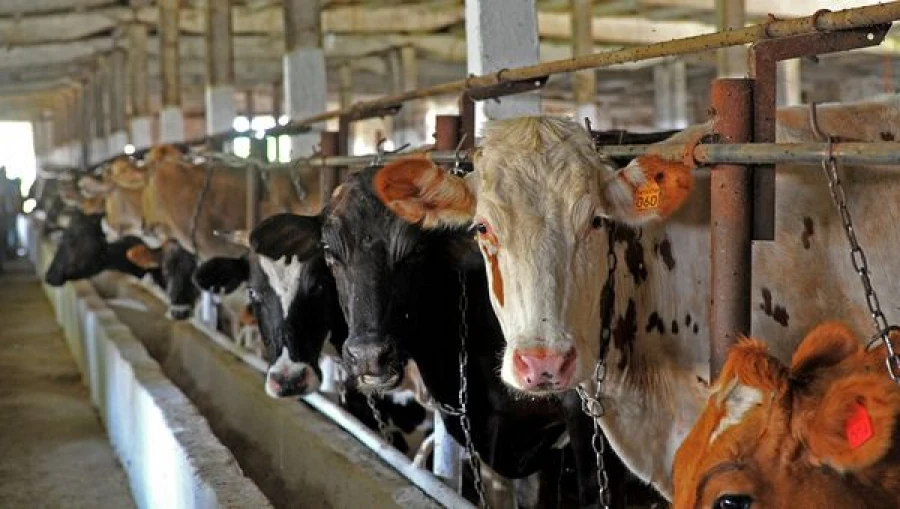
Compared to 2024, the production volume increased by 3.2%. At the same time, the number of cows rose to 934,881 heads, which is 1.8% more than the previous year. On average, one cow in the republic produces 2,114 kg of milk per year.
Interestingly, 92.6% of all agricultural production in the country is provided by farms and personal subsidiary plots. The dairy sector is also largely oriented towards small-scale production, remaining predominantly small-scale commodity.
| Milk production, tons | 1,823,796.7 | 1,881,506.0 | +3.2% |
| Cattle population, heads | 918,507 | 934,881 | +1.8% |
| Average milk yield per cow, kg | — | 2,114 | — |
Regional structure of milk production
Milk production in Kyrgyzstan is unevenly distributed across regions. Three regions — Chui, Jalal-Abad, and Osh — account for 66% of the total milk volume in the country. The Chui region provides more than a quarter (26.3%) of the total volume, despite ranking fourth in the number of cows (17% of the total population). This is due to the high productivity of livestock in this region.
The Osh region ranks first in the number of cattle (22% of the total population), but third in milk production (19%). A similar situation is observed in the Jalal-Abad region, which has 21% of the cattle population and 20.7% of milk production.
The cities of Bishkek and Osh contribute only a small share to production: less than 1.1% of the total volume. In Bishkek, milk production volumes fell to 54% of the 2024 level, while in Osh — to 88.1%.
| Chui region | 495,577.3 | 107 | 26.3% | 314,639 | 17% |
| Jalal-Abad region | 389,529.8 | 102.2 | 20.7% | 390,230 | 21% |
| Osh region | 357,849.7 | 103.3 | 19% | 408,600 | 22% |
| Issyk-Kul region | 286,380.3 | 102.8 | 15.2% | 287,977 | 15.5% |
| Naryn region | 148,368.5 | 102.2 | 7.9% | 219,362 | 11.8% |
| Batken region | 106,861.4 | 103.3 | 5.7% | 151,307 | 8.1% |
| Talas region | 77,377.1 | 100.8 | 4.1% | 70,556 | 3.8% |
| City of Osh | 10,325.2 | 88.1 | 0.5% | 11,207 | 0.6% |
| City of Bishkek | 9,236.7 | 54 | 0.5% | 4,599 | 0.2% |
| Kyrgyz Republic, total | 1,881,506 | 103.2 | 100% | 1,859,010 | 100% |
Differences in productivity by regions
The average milk yield per cow in the country is 2,114 kg per year; however, productivity varies significantly between regions. In Bishkek, the average yield reaches 3,338.5 kg, which is 1.6 times higher than the national average. In the Chui region, this figure is 3,203.2 kg, in the Talas region — 2,352.1 kg, and in the Issyk-Kul region — 2,164 kg.
In other regions, the yield is below the national average. The highest productivity indicators are recorded in the suburban areas of the Chui and Issyk-Kul regions, where milk processing and sales are better developed.
| City of Bishkek | 3,338.5 | 1.58x |
| Chui region | 3,203.2 | 1.52x |
| Talas region | 2,352.1 | 1.11x |
| Issyk-Kul region | 2,164.0 | 1.02x |
| Kyrgyz Republic, average | 2,114.0 | 1.00x |
As of February 1, 2026, the highest yield at the district level was recorded in the Issyk-Ata district of the Chui region at 241.8 kg, as well as in the cities of Kant (233.7 kg) and Bishkek (208.5 kg).
| Issyk-Ata | Chui | 5,236.6 | 244.7 |
| Jeti-Oguz | Issyk-Kul | 5,392 | 149.4 |
| Sokuluk | Chui | 4,932 | 190.8 |
| Kara-Suu | Osh | 4,770.9 | 104.3 |
| Moscow | Chui | 3,636.7 | 196.2 |
| Nookat | Osh | 3,537.5 | 104.6 |
| Tyup | Issyk-Kul | 3,250.4 | 140 |
| Issyk-Kul | Issyk-Kul | 2,945.7 | 147.1 |
| Suzak | Jalal-Abad | 2,739.6 | 69.2 |
| Chui | Chui | 2,823.2 | 183.6 |
Market prices for bulk milk
In 2025, the average price for bulk unpasteurized milk was 62.49 soms per liter, which is 6% higher than in 2024 (58.95 soms). Price dynamics throughout the year were influenced by seasonal fluctuations, as in 2024.
In December 2025, the highest price for bulk milk was recorded in Bishkek — 76.44 soms per liter, while the lowest price was observed in the Osh region — 52.41 soms. The difference between the maximum and minimum price was 24.03 soms, which equals 45.8%.
Throughout the IV quarter of 2025, milk prices increased in all regions. In some regions — Batken and Talas — prices remained stable in October and November, with an increase observed in December.
| City of Bishkek | 63.71 | 71.92 | 68.23 | 71.09 | 76.44 |
| City of Osh | 53.45 | 62.45 | 60 | 60.24 | 67.12 |
| Jalal-Abad region | 58.26 | 64.38 | 61.18 | 64.14 | 67.82 |
| Chui region | 56.14 | 60.68 | 60.02 | 61.02 | 61.02 |
| Batken region | 62.22 | 59.26 | 59.26 | 59.26 | 59.26 |
| Issyk-Kul region | 53.13 | 58.07 | 56.27 | 57.94 | 60 |
| Naryn region | 50.2 | 53.08 | 50 | 50 | 59.23 |
| Talas region | 49.82 | 52.83 | 52.71 | 52.71 | 53.06 |
| Osh region | 49.35 | 51.49 | 51.38 | 50.68 | 52.41 |
| Average for the Kyrgyz Republic | 59.39 | 66.3 | 63.5 | 65.4 | 70 |
Monthly dynamics of consumer prices for milk
The consumer price indexes for bulk milk throughout 2025 demonstrated clear seasonality. From March to July, prices decreased, with an index below 100% during these months. The minimum value was recorded in March and July (97.5%), which is associated with the mass grazing of livestock and an increase in supply.
Starting in August, prices began to recover, and in October there was a sharp increase — by 7.2% compared to September. In December, the increase was another 7%. Thus, in the last three months of the year, milk prices increased by 17.3% (October-December, cumulative compared to September).
| January | 100.8 | Moderate growth |
| February | 100.3 | Stability |
| March | 97.5 | Decrease |
| April | 97.3 | Decrease |
| May | 98 | Decrease |
| June | 99.4 | Decrease |
| July | 97.5 | Decrease |
| August | 100.1 | Stability |
| September | 101.4 | Beginning of growth |
| October | 107.2 | Sharp growth |
| November | 102.4 | Growth |
| December | 107 | Sharp growth |
Producer prices for raw milk
The producer price index for raw milk from January to December 2025 was 106% compared to the same period in 2024. This corresponds to a retail price increase of 6% over the year.
Analysis of monthly dynamics shows similar seasonality: a decrease in prices in the spring-summer period (the lowest level in June — 93.3% compared to May) and an increase in the fall. The highest monthly growth was recorded in October — +8.8% compared to September.
In annual terms (compared to the corresponding month of the previous year), producer prices for milk were higher than the 2024 level in every month except June. The maximum excess occurred in October (112.7% compared to October 2024).
| January | 105 | 103.8 |
| February | 100.4 | 105.5 |
| March | 98.3 | 110.2 |
| April | 99.3 | 105.7 |
| May | 97.8 | 104.7 |
| June | 93.3 | 96.5 |
| July | 103.4 | 102.6 |
| August | 101.6 | 104.1 |
| September | 101.6 | 104.2 |
| October | 108.8 | 112.7 |
| November | 98.6 | 105 |
| December | 104.1 | 106 |
Over the year, milk prices increased by 6%. In the context of the overall increase in producer prices for agricultural products in December 2025, which amounted to 15.5% compared to December 2024, milk prices rose more slowly.
Prices for dairy products, cheese, and eggs
In 2025, prices for the group "Dairy products, cheese, and eggs" increased by 5.5% compared to December 2024. Price increases were observed in all regions except for the Osh and Talas regions, where decreases of 8.1% and 1.4% were recorded, respectively. The maximum price increase for this group was 6.7% in the Jalal-Abad region.
In December 2025, compared to the previous month, prices for dairy products, cheese, and eggs increased by 4.3%, including for bulk milk — by 7%, and for chicken eggs — by 7.3%.
| Dairy products, cheese, and eggs | 104.3% | 105.5% | 101.3% |
| Food products overall | 101% | 109.9% | 100.8% |
Consumption of milk and dairy products
According to household surveys, the per capita consumption of milk and dairy products (converted to raw product) in 2024 was 19.2 kg per month, which is lower than the figure for 2023 (19.9 kg) but higher than the levels of 2020–2022.
The dynamics over the last five years show an increase in consumption from 18.2 kg in 2020 to 19.9 kg in 2023, with a slight decrease in 2024. Milk and dairy products still constitute one of the largest categories in the food diet — only bread (7.3 kg) and vegetables (17.8 kg) are consumed in larger volumes, but in absolute kilograms, dairy products take first place.
| Milk and dairy products | 18.2 | 18.5 | 18.4 | 19.9 | 19.2 |
| Vegetables and melons | 15.4 | 14.5 | 14.8 | 15.8 | 17.8 |
| Potatoes | 8.9 | 9 | 8.8 | 8.9 | 8.5 |
| Bread and bakery products | 7.3 | 5.8 | 7.3 | 6.9 | 7.3 |
| Fruits and berries | 2.8 | 2.7 | 3.7 | 5.8 | 6.3 |
| Meat and meat products | 3.6 | 3.7 | 3.9 | 3.9 | 4.2 |
Capacity of the domestic milk market
The capacity of the domestic milk and dairy products market in 2024 was 1,509 thousand tons. Over the past four years, this figure has increased by 175.7 thousand tons — from 1,333.3 thousand tons in 2020.
Milk production in 2025 (1,881.5 thousand tons) exceeds the market capacity of 2024 by 372.5 thousand tons, or 24.7%. This indicates that about a quarter of the produced milk is used for processing, export, animal feeding, or is lost.
| 2020 | 1,333.3 | 1,668 | +334.7 |
| 2021 | 1,374.1 | 1,698.9 | +324.8 |
| 2022 | 1,387.7 | 1,734.1 | +346.4 |
| 2023 | 1,532.6 | 1,777.6 | +245 |
| 2024 | 1,509 | 1,823.8 | +314.8 |
| 2025 | — | 1,881.5 | — |
Historical dynamics of milk production: 2018–2025
Milk production in Kyrgyzstan has shown steady growth since 2018. During this period, the volume increased by 291.8 thousand tons, which is 18.4%. The average annual growth rate is about 2.4%.
| 2018 | 1,589.7 | — |
| 2019 | 1,627.8 | +2.4% |
| 2020 | 1,668 | +2.5% |
| 2021 | 1,698.9 | +1.9% |
| 2022 | 1,734.1 | +2.1% |
| 2023 | 1,777.6 | +2.5% |
| 2024 | 1,823.8 | +2.6% |
| 2025 | 1,881.5 | +3.2% |
The annual growth rate in 2025 was the highest for the entire observation period — 3.2%.