Many drivers, looking at the sidewall of the tire where the maximum pressure is indicated, mistakenly believe that this is the value to which they should inflate the tires. However, this practice can lead to overinflation, making the vehicle's movement unsafe. The maximum value indicated on the tire is not the working pressure but merely a limit that the structure can withstand without damage. For normal operation, this number is too high.
The optimal pressure for the tire is set by the vehicle manufacturer, not the tire manufacturers. Engineers take into account the weight of the vehicle, weight distribution, type of suspension, and the characteristics of the tires themselves. Therefore, the recommended pressure is usually significantly lower than the maximum value indicated on the sidewall. To find it, it is best to refer to the sticker located in the driver's door frame, which indicates the optimal pressure for the front and rear axles, as well as for various operating conditions. This information can also be found in the vehicle's owner's manual.
If you rely on the maximum pressure indicated on the sidewall, the tires will be overinflated. This causes the tire tread to bulge in the center, with only the central strip making contact with the road, while the shoulder areas do not touch the asphalt. The rubber wears unevenly, reducing its lifespan, and the stiff tires cannot effectively absorb road irregularities. This makes driving less comfortable and increases the likelihood of breakdowns.
Moreover, overinflated tires have reduced grip, especially on wet roads, which increases the braking distance and decreases stability in turns. The rigid tire structure becomes more vulnerable to impacts, increasing the risk of damage or rupture, similar to an over-inflated balloon that bursts more easily upon impact.
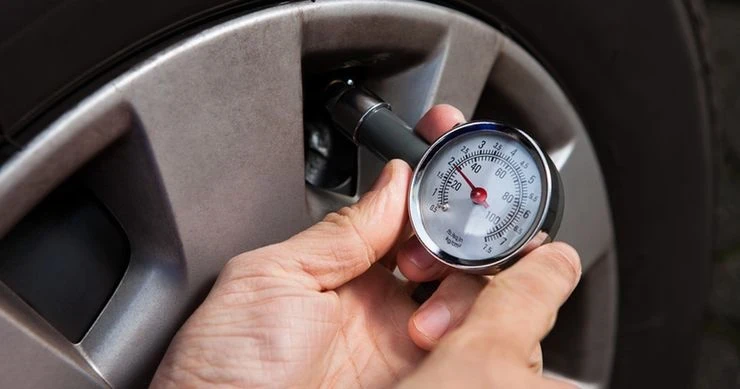
The correct approach to inflating tires is simple: first, refer to the table with the recommended pressure, then set the desired value on the compressor and check the result with a separate gauge. Modern vehicles often have a Tire Pressure Monitoring System (TPMS) that displays the pressure in each tire on the dashboard and warns of any decrease, but even this does not replace the basic recommendations from the manufacturer.
Temporary deviations are sometimes acceptable. For example, when towing a heavy trailer, it may be necessary to slightly increase the pressure in the rear tires, but without exceeding the limits specified by the manufacturer, and especially not going beyond the maximum value indicated on the tire. At the same time, when driving on sand or soft ground, the pressure can be reduced to increase the contact patch. However, for regular driving on asphalt, the only correct solution remains to inflate the tires to the recommended value and ignore the maximum pressure on the sidewall.
It was previously reported that in winter, the advice to "deflate tires for better grip" is common.
Expert Dmitry Novikov, in a conversation with 32CARS.RU, noted that while this technique can indeed help, it is not suitable for all conditions and not for all vehicles.
On loose snow off-road, reducing pressure does indeed increase the contact patch, allowing the tire to grip the surface better. At a pressure of 1.0–1.2 atmospheres, it can significantly ease getting out of a snowdrift. But it is important to remember that this is a temporary measure. At such pressure, sharp turns, acceleration, or braking are prohibited, as the risk of the tire slipping on the rim or being damaged increases.
Extreme pressure values used by off-road vehicles require experience and appropriate driving conditions. On asphalt and compacted snow, the correct pressure and tread quality play a key role. An under-inflated tire can lead to poor handling and increased braking distance, as well as raise the risk of sidewall damage from hidden potholes.
Equally important: after reducing pressure, it must be restored immediately. Continuing to drive on under-inflated tires is a bad idea that will not only fail to improve grip but will also shorten the lifespan of the tires and reduce safety.
So, the conclusion is clear: the life hack works only on loose snow off-road and only for a short time. For urban conditions and highways, it is most important to maintain normal pressure and use quality winter tires, which will ensure safety in the 2025 automotive season.
Experiments with pressure are the domain of off-road vehicles. For regular drivers, it is more reliable to adhere to standards rather than risk where the cost of error can be too high.