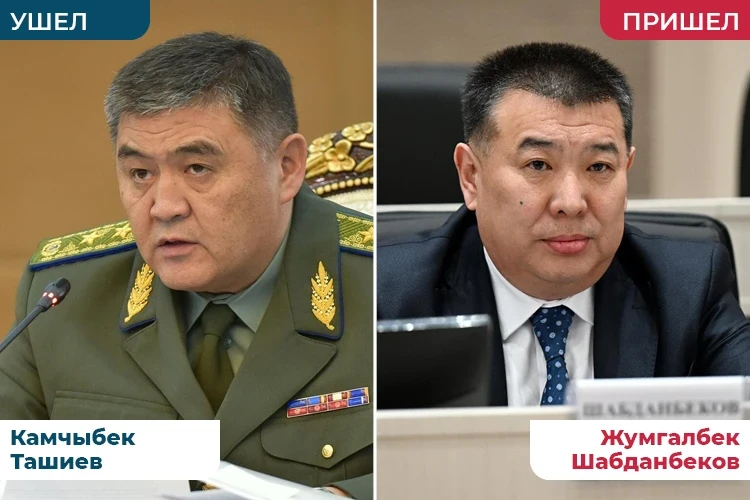
However, the surprise lies not so much in the resignations themselves but in the fact that they did not happen earlier, during the so-called "first wave".
But how can we explain the president's statement that after Tashiev's dismissal, they continued to communicate and remained friends? This statement clearly contradicts the ongoing changes in the personnel structure.
The answer may lie in the fact that these significant personnel changes are not merely about "trusting or not trusting" but indicate deeper changes in the power structure.
The System's Attitude Towards the Individual
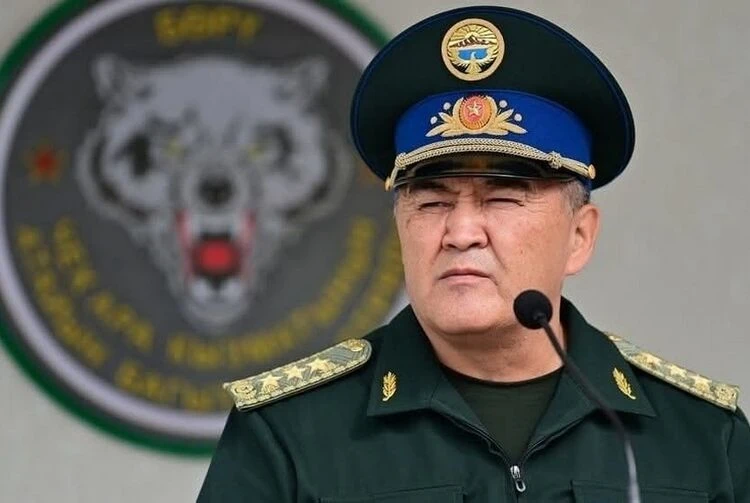
In recent years, Kamchybek Tashiev has played a significant role in Kyrgyz politics. Under his leadership, the GKNB significantly expanded its influence, encompassing even areas not related to the powers of the special services. The general became a central figure not only in security matters but also in political, economic, and personnel management, forming his own network of influence that included officials, deputies, and businessmen.In such a system, power began to transform from a state structure into a network of personal dependencies. It is not necessarily that this was a deliberate action by Tashiev; rather, it became a result of an unconscious process.
In contrast, another process began.
In any presidential model, there is a limit to the permissible autonomy of the second center of power.
In the early stages of growth, such a distortion in the distribution of powers may be effective, but it cannot last forever. After the growth phase comes the stabilization stage, during which there arises a need to redistribute influence to reduce the risks of power monopolization.
This is precisely what we are witnessing now.
The system of tandems has reached its limit, and the process of returning to a classic model of centralization has begun.
Simply put, the defenders of the duumvirate could not deceive the nature of power, and two heads in one pot cannot coexist for long.
What is Actually Changing
The changes concern not the composition of the elite but the principle of access to power. If previously the key factor was trust in a specific individual, now the emphasis shifts to subordination to the presidential vertical. This is a transition from a tandem model to a centralized power structure.Although the difference is slight, it is fundamentally significant.
As for the resignations, they typically occur in waves.
The first wave affects the highest level and symbolic figures — this includes the dismissal of Kamchybek Tashiev himself, his deputies in the GKNB, the heads of the Bishkek administration, the speaker of the Jogorku Kenesh, and the mayor of Osh.
The next wave concerns the infrastructure of influence, including the departure of deputies, as well as the resignations of Bakyt Torobaev and Kanybek Dosmametov.
The third wave affects networks of personal agreements, at the level of "brother's friend" and others.
The Fate of Tashiev's Personnel
Three scenarios for the development of events are possible. The first can be called integration: some officials will be adapted and retained in the system, as mass dismissal of personnel resources is costly and risky. The main condition is the reorientation of personal loyalty to institutional loyalty.The second scenario concerns those whose identity is too closely tied to the former center of influence, that is, those who are directly associated with Tashiev. They will find it difficult to stay afloat, and most of them will likely have to leave for business or exit the system altogether.
The third scenario involves rationally thinking supporters of the general, who, realizing that the previous configuration will not be restored, decide to leave. An example of this could be Nurlan Shakiev.
However, despite the scale of the personnel purge, this is not a conflict in the traditional sense.
There is no public war, which means it is not about a split but about a redistribution of influence. This is not a struggle to the death but a correction of the balance.
Historically, the Kyrgyz political system has oscillated between personalism and attempts to create a stable vertical of power. At this moment, the pendulum is leaning towards the latter.