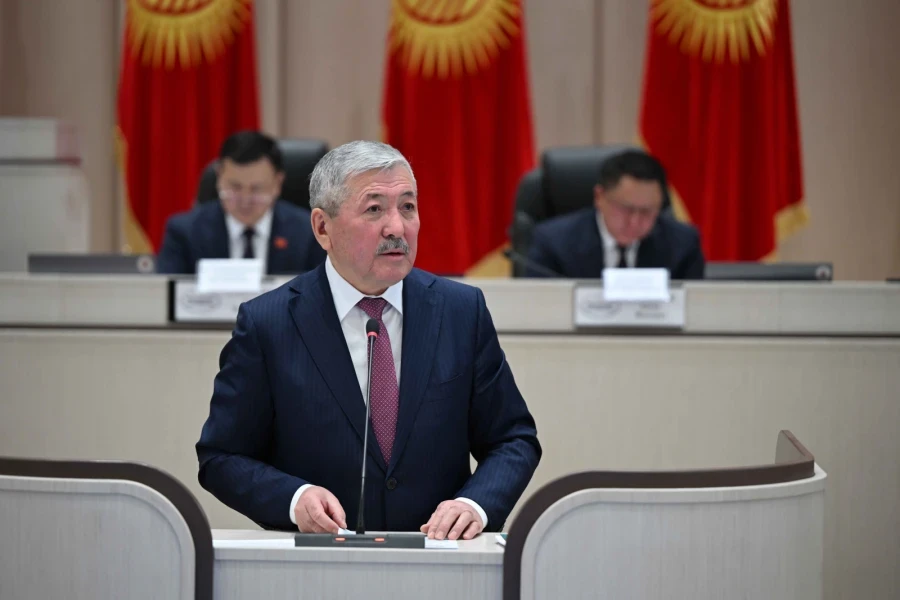
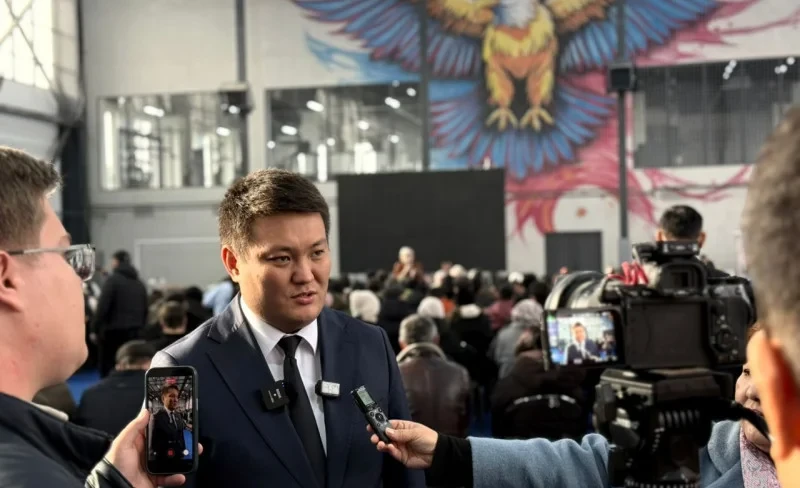
In the interview, the minister also discussed the situation at Kumtor, mineral reserves, the carbon market, critical minerals, and the ministry's plans for the coming years.
Text of the interview:
- What efforts is the Ministry of Natural Resources making to improve environmental legislation?
- One of our main tasks is the continuous updating and improvement of the regulatory framework. In particular, over the past two years, we have initiated the adoption of significant laws, including restrictions on the use of plastic products, which came into effect at the beginning of this year.
Additionally, last year, a law on production and consumer waste was adopted, introducing a recycling fee for 24 categories of goods. This marks the beginning of implementing the principle of extended producer responsibility. We established the eco-operator "Eco Operator," which has already collected about 60 million soms for waste disposal, including plastic and harmful packaging materials. Work on new laws is ongoing.
We are currently preparing a draft law on climate activities, which will serve as the basis for the carbon market. A new Environmental Code is also being developed, with its adaptation already in the final stages.
Regarding subsoil use, we continue to improve legislation, specifically preparing a package of amendments to the subsoil law. We aim to adopt a Subsoil Code to meet the requirements of neighboring countries.
- Kyrgyzstan has updated its commitments under the UNFCCC 3.0. What are the reasons for the changes compared to previous goals?
- You are absolutely right; this is a strategic document that we have adopted. In UNFCCC 3.0, we plan to reduce greenhouse gas emissions by 18% by 2030, which is 2% more than in the previous UNFCCC 2.0 document. Our ultimate goal is carbon neutrality by 2050.
The main changes concern the adaptation plan, which has been updated due to frequent natural disasters and climate changes. This document will serve as the basis for future climate activities under the UN Framework Convention.
- What measures are being taken to maintain the water level in Lake Issyk-Kul?
- This year, we approved a concept for the development of the ecological and economic system of Issyk-Kul and plan to hold the first meeting with interested government agencies. The concept includes the development of measures to monitor the lake's condition, as the shallowing has a cyclical nature.
We are conducting research in collaboration with international organizations, such as the Institute of Oceanology of the Russian Academy of Sciences. The results of this research will help create observation and monitoring protocols for the hydro-physical and hydro-chemical state of Issyk-Kul.
- How is waste recycling progressing in the country?
- Waste management is an important part of our work. Over the past few years, the number of illegal dumps has decreased from 400 to 220 due to improved organization of landfills. We have also started work on the first waste incineration plant in Bishkek, which is already successfully processing up to 1,200 tons of waste per day and generating electricity.
- What is the status of the ban on plastic bags?
- The law banning plastic bags is already in effect, but we are facing certain difficulties in its implementation. Currently, it applies only in the Issyk-Kul region and protected areas, and from 2027 it will be extended to the entire country. We are working on regulating the production of alternative products.
- What is the situation with wastewater treatment facilities in Issyk-Kul?
- Wastewater treatment facilities are a significant problem, especially with the growing population. We have created an interagency working group to monitor the condition of wastewater treatment facilities and plan to present a concept for improving this system to the Cabinet of Ministers at the beginning of next year.
- What are the ministry's plans to combat poaching?
- The President of the country actively supports the fight against poaching. We continue to clear the waters of Issyk-Kul of poaching nets and work together with other government structures to enhance the effectiveness of combating this problem.
- What measures are being taken to improve air quality in Bishkek?
- We are implementing an action plan to combat smog, receiving funding from the World Bank. This year, we started several projects, including a re-evaluation of air quality to assess changes.
- What are the current mineral reserves in Kyrgyzstan?
- According to the state commission, gold reserves amount to about 980 tons, and there are also reserves of silver, copper, and coal. We continue geological exploration, which affects these figures.
At Kumtor, increases in reserves have been registered, and the construction of a gold extraction plant at the Togolok deposit is planned.
- What are the conditions for obtaining licenses for the development of deposits?
- In 2021, a moratorium was introduced on issuing licenses for gold, copper, and silver for private companies. We are focused on streamlining this area and conducting auctions for non-metallic minerals.
- What major donor-funded projects is the ministry implementing?
- We are involved in several dozen projects, including funding from the World Bank. As part of climate activities, we approved a country program for working with the Green Climate Fund, for which six promising projects have been submitted.
- What is the ministry's further strategy?
- We are actively preparing for the Mountain Summit in 2027 and plan to hold preliminary events and discussions at international forums.
- What is happening with critical mineral deposits?
- We are finalizing the strategy for the development of critical minerals and seeking investors for promising deposits such as Kutessai and Andash.
- What are the plans for improving nature conservation in Kyrgyzstan?
- We are actively working to enhance the protection of natural areas and ecotourism, and we continue to combat poaching.
Our task is to ensure sustainable development and protect nature for future generations.
- What measures are being taken to improve fish conservation?
- We continue the fight against poaching, including clearing the waters of Issyk-Kul of nets. Work is being carried out in collaboration with various government structures.
- What is the status of monitoring wastewater treatment facilities?
- We are monitoring the condition of wastewater treatment facilities in large settlements and plan to present a concept for improving this system to the Cabinet of Ministers at the beginning of next year.
- What are the plans for improving air quality in Bishkek?
- We are implementing an action plan to combat smog and continue to work with international partners to improve the air quality situation in the city.
We are focused on sustainable development and environmental protection for future generations.